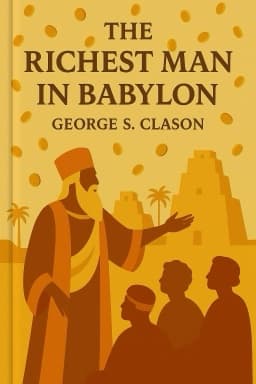
George S. Clason
Timeless financial wisdom from ancient Babylon, teaching practical steps to wealth through engaging parables.
The book was originally published as a series of pamphlets distributed by banks and insurance companies.
Section 1
7 Sections
Let us begin our journey not with the clang of coins, but with the gentle rustle of river reeds and the hopeful hum of a city rising from dust. Picture Babylon, a city born not from nature’s bounty but from the determined hands of its people. There were no forests to fell, no mines to plunder—just a flat, arid valley beside the Euphrates. Yet here, humanity’s oldest dream took root: to turn nothing into something, to transform barren earth into a garden of abundance.
The Babylonians, ancient as they were, understood something we often forget: that prosperity is not a matter of fate. They built canals, diverting the river’s life-giving waters to the thirsty soil. They raised walls so grand that even the world’s greatest armies stood in awe. Their city became a beacon—a place where merchants, artisans, and dreamers from every corner of the world gathered to trade, to learn, and to grow.
But what made Babylon truly unique was not its gold or its gardens, but its wisdom. The Babylonians wrote their knowledge on clay tablets—laws, contracts, stories, and advice—all inscribed with care and preserved for the centuries.
Imagine a bustling market square: the chariot builder haggling for timber, the scribe negotiating a contract, the farmer selling the fruits of his labor. Each transaction is a lesson, each agreement a step toward a future none could have built alone.
As we step into the next section, remember: the story of Babylon is not just history—it is a mirror, reflecting our own potential to create abundance from nothing. Let us now explore the timeless principles that turned this city into a legend, and see how they can guide us today.
What natural resources did Babylon lack?
13 more quizzes available in app
Wealth is created through collective ingenuity, not luck.
7 more insights available in app
Unlock all 7 sections, 8 insights, full audio, and interactive mind map in the SnapBooks app.
Dave Ramsey

Chris Hogan

Vivian Tu

Thomas J. Stanley, Ph.D. and William D. Danko, Ph.D.
