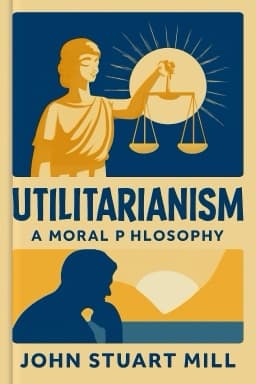
John Stuart Mill
A foundational ethical treatise advocating that the greatest happiness for the greatest number is the standard of morality.
John Stuart Mill coined the term 'utilitarian' to describe followers of the utility principle.
1 more facts available in the app
Section 1
7 Sections
Imagine standing at the crossroads of human thought, where for centuries, the brightest minds have grappled with a profound question:
One might expect that morality, as a practical art guiding action, would have a clear starting point—a principle so evident that it requires no further proof. Yet, paradoxically, the detailed doctrines of sciences often precede their first principles, while in ethics, the ultimate ends seem elusive, making the search for a criterion of right and wrong all the more urgent.
Some have turned to the notion of a natural moral sense or instinct, believing it to be an innate faculty that informs us of moral truths. However, this instinct does not function like our senses of sight or hearing; it does not provide direct perception of particular moral cases. Instead, it offers only general principles, leaving the application to individual situations to reason and reflection.
Philosophers have divided into schools—some claiming moral principles are self-evident and known a priori, others insisting they arise from experience and observation. Yet, both agree on the necessity of general laws governing morality. The difficulty lies in the absence of a universally acknowledged first principle to unify these laws, leading to a fragmented moral landscape.
Nevertheless, even amid this uncertainty, a tacit standard has influenced moral beliefs: the principle of utility or the greatest happiness principle. This principle, though not always explicitly recognized, has shaped moral doctrines by emphasizing the consequences of actions on human happiness.
As we reflect on this enduring quest, we realize that the challenge is not simply to accept moral precepts but to understand their ultimate basis. This understanding requires us to look beyond instinct and tradition, toward a principle capable of guiding us through the complexities of moral life.
With this foundation laid, we turn now to explore the principle that has quietly but powerfully shaped moral thought—the principle of utility. This principle will illuminate the path forward, offering a lens through which to view right and wrong not as abstract ideals but as practical guides to human happiness.
What is the main problem in moral philosophy discussed in this section?
13 more quizzes available in app
Understanding why the foundation of morality has been a persistent philosophical puzzle.
7 more insights available in app
Unlock all 7 sections, 8 insights, full audio, and interactive mind map in the SnapBooks app.
Discover how Mill’s utilitarianism reshaped morality with a focus on happiness and justice for all
Read articleExplore how utilitarianism’s focus on happiness and justice can transform personal and social ethics
Read article