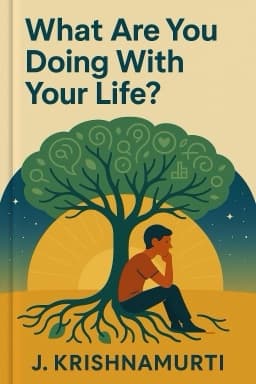
J. Krishnamurti
A transformative guide to self-knowledge, psychological freedom, and the art of living, by one of the 20th century’s greatest spiritual teachers.
Krishnamurti was discovered as a child by leaders of the Theosophical Society, who believed he was destined to be a world teacher.
Section 1
6 Sections
Let me invite you into a gentle story, a journey that begins with a single, simple question:
In the stillness, you begin to notice your thoughts—how they come and go, how they shape your feelings and actions. You realize that much of what you believe about yourself has been given to you: by parents, teachers, society, and tradition. These are like layers of dust on a mirror, obscuring your true reflection. Krishnamurti teaches that
It’s a process—a living, breathing journey. Each day, each encounter is a chance to learn. There’s no final destination, no point at which you can say, 'I know myself completely.' Instead, self-knowledge is like tending a garden: it requires patience, gentle attention, and a willingness to see what grows, even the weeds.
Here’s a beautiful truth:
And you don’t need a guru, a system, or a set of rules to begin. The most profound insights arise when you look directly, honestly, and without judgment at your own mind. This is the mirror of self-knowledge, and it is always available to you.
As you reflect on these ideas, imagine the ripple effect: your clarity, your kindness, your understanding touching others and spreading outward. This is how real change happens—not through revolutions or reforms, but through the quiet revolution within.
Let’s take this gentle awareness forward, into the next chapter of our story—where we explore the roots of suffering and the healing power of awareness.
What is the foundation of self-knowledge according to Krishnamurti?
11 more quizzes available in app
Knowing yourself is not a static achievement but a continuous journey.
7 more insights available in app
Unlock all 6 sections, 8 insights, full audio, and interactive mind map in the SnapBooks app.
Discover the timeless teachings of J. Krishnamurti and how they can empower your journey today.
Read articleA practical guide to dissolving the root causes of suffering, inspired by Krishnamurti’s revolutionary approach.
Read article