
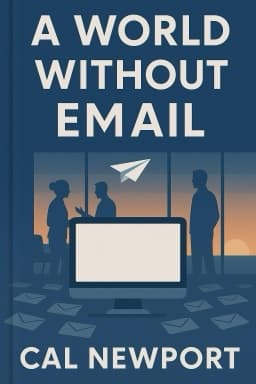
What If You Never Checked Email Again? The Surprising Science of Focus and Productivity
How Escaping the Inbox Could Change Your Life and Your Company

How Escaping the Inbox Could Change Your Life and Your Company
Picture your typical morning: you sit down, coffee in hand, and before you can even think about your most important work, you’re pulled into a swirling tide of emails, notifications, and urgent requests. Sound familiar? You’re not alone. According to research cited in Cal Newport’s groundbreaking book, A World Without Email, the average knowledge worker checks their inbox every six minutes, often toggling between dozens of threads and tasks before noon. Yet, despite all this activity, most of us end the day feeling scattered, unproductive, and quietly exhausted.
Why does email—originally designed to make work easier—leave us feeling so overwhelmed? Newport traces the root of the problem to what he calls the 'hyperactive hive mind': a workflow built on unstructured, ongoing digital conversations. In this system, every request, question, or update becomes an instant message, demanding immediate attention and fragmenting our days into a thousand micro-tasks. The result? Attention residue—the mental drag created by switching between unfinished tasks—accumulates, making it nearly impossible to do focused, creative work.
But it gets worse. Our brains, shaped by millennia of social evolution, treat every unread message as a neglected tribe member. Ignoring an email triggers the same ancient anxieties as ignoring a plea for help around the campfire. This evolutionary mismatch means that even when we know a message isn’t urgent, we feel compelled to check, respond, and stay in the loop. Over time, this leads to chronic stress, burnout, and a sense of never truly being 'done.'
So what’s the alternative? Newport offers a radical but hopeful vision: redesign work from the ground up to protect attention, minimize interruptions, and value deep work. He shares stories of companies that have experimented with five-hour workdays, banned email one day a week, or replaced ad hoc requests with structured systems like ticketing or project boards. The results are striking: shorter hours, higher productivity, and happier teams. Even IT departments—once drowning in support emails—found that structured workflows reduced interruptions and improved service.
But change isn’t easy. Newport emphasizes that innovation is inconvenient at first. Teams that succeed start small, piloting new processes quietly and measuring results before scaling up. The key is to involve employees in designing workflows, building motivation and ownership from the ground up. Over time, the initial discomfort fades, replaced by smoother collaboration, clearer priorities, and a renewed sense of purpose.
Ultimately, Newport’s message is not anti-technology, but pro-intention. The goal isn’t to ban email, but to use it wisely—supporting, not sabotaging, human potential. As more organizations recognize that attention is their most valuable asset, a new era of work is dawning—one where focus, creativity, and well-being are not just possible, but expected. Imagine closing your laptop at the end of the day, knowing you’ve done your best work—and your inbox can wait until tomorrow.
Ready to escape the inbox? The journey begins with a single step: reclaim your attention, and watch your work—and your life—transform.
Want to explore more insights from this book?
Read the full book summary