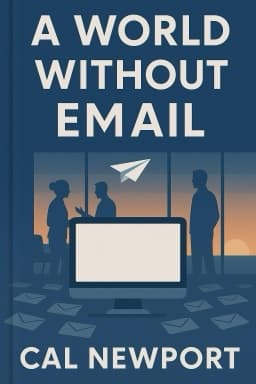
Cal Newport
A bold blueprint for replacing email overload with smarter, more sustainable ways of working.
Cal Newport is a computer science professor who has never had a social media account.
Section 1
8 Sections
Let’s begin our journey with a gentle reflection: how did something as simple as email, a tool designed to make life easier, quietly transform our workdays into a blur of constant activity? Imagine an office, not so long ago, where messages arrived by memo or were delivered by hand, and a day was shaped by a handful of focused meetings. Then, almost overnight, a new rhythm took hold—one of digital pings, urgent notifications, and a growing sense of being always 'on.'
It happened so quietly that few noticed. Messages that once required effort to send—writing, walking, waiting—could now be fired off in seconds. At first, it felt liberating: you could reach anyone, anywhere, at any time. But as the cost of communication dropped to nearly zero, the volume of messages exploded. Entire teams found themselves drowning in an ever-rising tide of requests, CCs, and follow-ups.
Research soon revealed the hidden cost: the average knowledge worker checked their inbox every six minutes, with some peeking in over seventy times a day. The promise of flexibility had become a curse of constant distraction. Productivity didn’t soar—it splintered. Instead of long, deep stretches of creative work, days fractured into a thousand micro-tasks, each demanding a sliver of attention but rarely yielding a sense of completion or progress.
And yet, no one planned this. The story of email’s rise is not one of careful strategy, but of technological determinism. The tool shaped the behavior, not the other way around. Offices that once relied on memos or even elaborate pneumatic tube systems to move messages suddenly found themselves with an embarrassment of communication riches—and the result was a new, invisible burden.
As we look around today’s office—real or virtual—we see the legacy of this invisible shift. The fatigue, the busyness, the sense of always being behind. But as with any story, understanding the beginning helps us see the path to change. As we move forward, let’s explore what this constant stream of messages is doing to our minds, our well-being, and our souls. The next chapter reveals the hidden toll of email on our happiness and health, and why so many of us feel quietly miserable in a world of endless digital chatter.
How often does the average knowledge worker check their email or instant messenger?
15 more quizzes available in app
A workflow dominated by constant, unscheduled digital messages.
7 more insights available in app
Unlock all 8 sections, 8 insights, full audio, and interactive mind map in the SnapBooks app.
How Escaping the Inbox Could Change Your Life and Your Company
Read articleHow Email Hijacks Your Brain and How to Take Back Control
Read article