
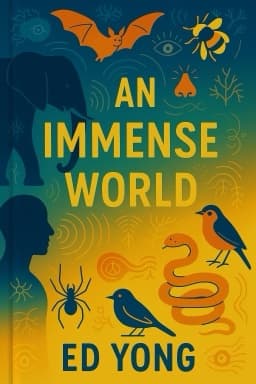
How Animals See the World Differently: The Mind-Blowing Science of Animal Vision
From boomerang-shaped retinas to hundreds of eyes, discover the incredible variety of animal vision systems.

Vision is often taken for granted as a singular sense, but across the animal kingdom, eyes have evolved into a stunning array of forms and functions. Contrary to the idea that eyes evolved from poor to perfect, they have diversified to excel at different tasks depending on an animal’s ecological needs.
Jumping spiders possess eight eyes, but their central pair is extraordinary. These eyes have boomerang-shaped retinas that move independently, scanning and focusing with remarkable precision. This allows the spider to detect color and track fast-moving prey despite having a tiny brain. The secondary eyes specialize in detecting motion, triggering the central eyes to investigate further.
Scallops, marine bivalves, have up to 200 eyes arrayed along the edge of their shells. These eyes use concave mirrors made of crystals to focus light onto two retinas, an optical innovation rarely seen elsewhere. Despite their numbers, scallop eyes likely do not form detailed images but detect motion and changes in light intensity, serving as an early-warning system against predators.
Eagles, iconic birds of prey, have visual acuity twice that of humans. Their retinas are densely packed with photoreceptors optimized for sharp daytime vision. This allows them to spot small rodents from over a mile away. However, this acuity comes at the cost of low-light sensitivity, making them less effective hunters at night.
Color vision varies widely. Some insects and birds see ultraviolet light invisible to humans, enabling them to detect patterns on flowers or plumage used in communication and mating. Primates evolved trichromatic vision to distinguish ripe fruits and young leaves, a crucial survival adaptation.
These diverse visual systems illustrate that what we see as vivid and detailed may be a blur or invisible to other animals. Understanding these differences enriches our appreciation of animal behavior and evolution.
Sources: Ed Yong’s An Immense World, Springer Nature, The Wall Street Journal.
Want to explore more insights from this book?
Read the full book summary