Ed Yong
A profound journey into the diverse sensory worlds of animals, revealing how their unique perceptions shape their realities.
Dogs can sniff six times per second, creating a continuous flow of scent information unlike humans who purge odorants when exhaling.
Section 1
7 Sections
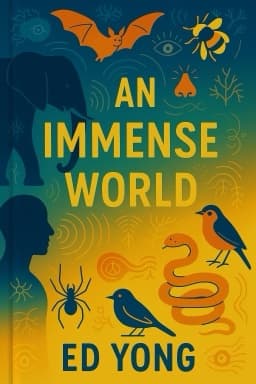
Imagine a room filled with an elephant, a bat, a bumblebee, a rattlesnake, a robin, a spider, a mouse, and a human. Though these creatures share the same physical space, each experiences it through a radically different lens.
Our human senses, especially vision, dominate our understanding of reality, but they represent only a sliver of what is possible.
These sensory differences matter profoundly. They shape how animals find food, avoid predators, communicate, and navigate their environments.
Understanding Umwelt challenges us to step outside our anthropocentric view and appreciate the richness of other sensory worlds.
As we explore further, we will uncover the remarkable ways animals use chemical senses like smell and taste to navigate invisible landscapes, perceive the world in ways beyond sight, and communicate through scents and pheromones. Let’s begin by diving into the most ancient and universal of senses: the chemical senses.
What does the term 'Umwelt' refer to?
13 more quizzes available in app
Each animal’s sensory capabilities create a unique perceptual world.
8 more insights available in app
Unlock all 7 sections, 9 insights, full audio, and interactive mind map in the SnapBooks app.
Discover the astonishing sensory worlds animals live in, far beyond human perception.
Read articleFrom boomerang-shaped retinas to hundreds of eyes, discover the incredible variety of animal vision systems.
Read article