
The Invisible World of Animal Smell and Taste: Chemical Senses That Blow Your Mind
Explore how animals use smell and taste to communicate, navigate, and survive in ways humans can barely imagine.

Smell and taste are among the oldest senses, yet they unlock worlds invisible to the human eye. Every animal is a 'leaking sack of chemicals,' constantly emitting molecules that convey identity, status, and intentions. These chemical cues form a rich language of survival and social interaction.
Dogs sniff six times per second, creating vortices that pull fresh odor molecules into their noses even during exhalation. This allows them to maintain a continuous stream of scent information, enabling them to track prey, detect danger, and recognize individuals with astonishing accuracy.
Elephants use their trunks like sensory antennae, detecting complex chemical signals that reveal family ties, reproductive status, and emotional states. Their olfactory abilities help maintain social bonds and alert them to threats. Similarly, ants communicate through a sophisticated chemical language of pheromones, coordinating colony activities such as alarm, foraging, and reproduction. Their olfactory receptor genes have expanded dramatically to support this complexity.
Male moths track female sex pheromones over miles, and seabirds follow chemical cues released by marine plankton to locate feeding grounds. Snakes flick their forked tongues to sample chemical cues in stereo, guiding precise behaviors in complete darkness.
Despite its importance, human olfaction is often underestimated, partly due to cultural biases and limited vocabulary for smells. Yet, with practice, humans can improve their scent detection, hinting at latent potential. Recognizing the richness of chemical worlds invites us to expand our sensory appreciation beyond vision and sound.
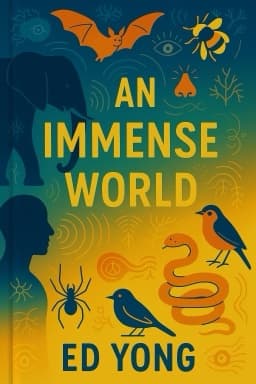
Sources: Ed Yong’s An Immense World, The Atlantic, National Geographic.
Want to explore more insights from this book?
Read the full book summary