
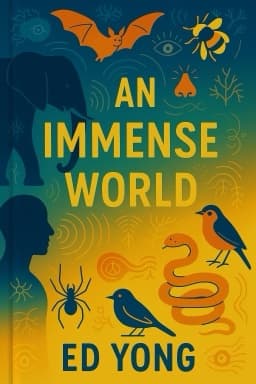
Unlocking the Secret Senses of Animals: You Won't Believe What They Can Detect!
Discover the astonishing sensory worlds animals live in, far beyond human perception.

Imagine a world where every creature perceives reality through a radically different lens. This is not science fiction but the fascinating truth revealed in Ed Yong's groundbreaking book An Immense World. The concept of Umwelt—the unique sensory bubble surrounding each animal—challenges our human-centric view and invites us to explore how animals sense the world in ways that are invisible, inaudible, and unimaginable to us.
Take the humble dog, whose nose is a marvel of evolutionary engineering. Dogs sniff six times per second, creating vortices that pull fresh scent molecules deep into their olfactory epithelium even during exhalation. This continuous flow enables them to track faint scent trails left hours or days earlier—something humans cannot do. Elephants use their trunks to detect complex chemical signals revealing identity and emotional states, while ants communicate through a sophisticated chemical language of pheromones that coordinate colony life.
Vision, often considered the dominant sense for humans, is wildly diverse across species. Jumping spiders boast boomerang-shaped retinas that move independently to focus on prey, scallops possess up to 200 eyes with reflective mirrors, and eagles have visual acuity twice that of humans, spotting prey from miles away. Some animals see ultraviolet light or colors beyond human vision, revealing a spectrum of perception that broadens our understanding of the natural world.
Touch and vibration provide immediate, localized information. Seals use whiskers to detect water ripples caused by prey, spiders interpret web vibrations to identify trapped insects, and octopuses explore their environment with tactile and taste receptors on their tentacles. These mechanosensory abilities connect animals intimately with their surroundings.
Sound extends perception beyond sight, especially in darkness or murky waters. Bats and dolphins use echolocation—emitting ultrasonic pulses and interpreting echoes—to navigate and hunt with astonishing precision. Owls’ asymmetrical ears allow pinpoint 3D sound localization, and whales communicate across vast ocean distances with low-frequency calls.
Beyond these familiar senses lie the electric and magnetic fields that some animals detect. Electric fish generate fields to locate prey, the platypus uses electrotouch via its bill to hunt underwater, and migratory birds sense Earth’s magnetic field to navigate thousands of miles. These invisible maps and signals reveal sensory dimensions utterly alien to human experience.
However, human activities threaten these delicate sensory environments. Light pollution, noise, and chemical contaminants disrupt animal communication and navigation, posing risks to biodiversity. Conservation efforts must include preserving sensory landscapes, recognizing that protecting animal senses is as vital as protecting habitats.
Understanding the immense world of animal senses expands our empathy and connection to the living world. It challenges us to see beyond our limited perception and appreciate the rich tapestry of life that surrounds us.
Sources: Ed Yong’s An Immense World, The New York Times, The Atlantic, Springer Nature.
Want to explore more insights from this book?
Read the full book summary