
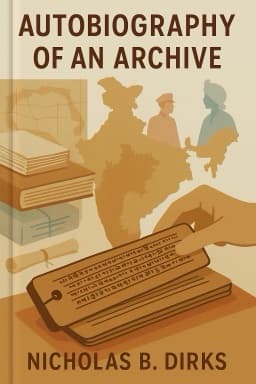
Unlocking the Secrets of South Asia: How Nicholas Dirks Redefines History and Power
Discover the hidden power dynamics within South Asia’s colonial archives and why this book is a must-read for understanding the region’s past and present.

When we think about history, we often imagine dusty archives as neutral vaults preserving the past. But Nicholas Dirks' The Idea of South Asia shatters this myth, revealing archives as powerful monuments wielded by states to define, control, and rewrite history. This groundbreaking book takes readers deep into the colonial archives of South Asia, especially the remarkable Mackenzie Collection, exposing the hidden mechanisms through which colonial power was exercised and contested.
Dirks reveals that archives were not just passive storage but active tools of imperial governance. They embodied the state’s desire to shape historical narratives that legitimized its rule. In premodern India, history was monumentalized through temple inscriptions and copper plates, blending political authority with sacred tradition. The British colonial state transformed this tradition into bureaucratic archives that classified populations, controlled land, and surveilled communities.
One of the most compelling parts of the book is the story of Colin Mackenzie and his Indian assistants. Mackenzie, a military surveyor and antiquarian, collected an unparalleled array of local histories, maps, and manuscripts. However, the indispensable contributions of native assistants like Boriah and Lutchmia were marginalized, highlighting the racial and institutional hierarchies embedded in colonial knowledge production.
Dirks also critically examines how the British colonial administration constructed the caste system as a rigid, hierarchical framework through censuses and anthropometric studies. Anthropologists like Edgar Thurston contributed to this essentialization, reinforcing social divisions for administrative convenience. Yet, caste was not merely a social reality but a colonial construct with profound political implications.
Rituals, too, emerge as contested arenas of power. Practices such as hookswinging were not just cultural performances but sites where colonial authorities and local communities negotiated control, resistance, and identity. These rituals illustrate the dynamic interplay between tradition and colonial regulation.
The book further delves into the ideological foundations of British imperial sovereignty, highlighting the East India Company’s hybrid commercial and political role and the invocation of the ancient constitution to legitimize colonial governance. This complex sovereignty shaped the political landscape of India and the production of knowledge about it.
Beyond historical analysis, Dirks reflects on the postcolonial condition, the politics of knowledge, and the role of universities and liberal arts education in engaging with these legacies. He traces how area studies emerged from wartime intelligence needs and how postcolonial critiques challenge the colonial epistemologies that continue to influence scholarship.
Dirks' work is a tour de force that combines history, anthropology, political theory, and critical reflection. It invites readers to reconsider how knowledge is produced, whose voices are heard, and how history itself is a contested terrain shaped by power. For anyone interested in South Asia, colonialism, or the politics of knowledge, The Idea of South Asia is an indispensable and transformative read.
By peeling back layers of archival dust and colonial ideology, Dirks opens a window into the past that illuminates the present, offering profound insights into the ongoing struggles over identity, power, and history in South Asia and beyond.
References: 1 3 4
Want to explore more insights from this book?
Read the full book summary