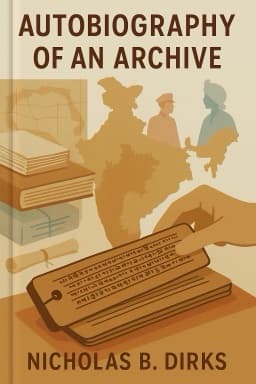
Nicholas B. Dirks
A critical and personal exploration of colonial archives, South Asian studies, and the intertwined histories of empire, knowledge, and academia.
Nicholas B. Dirks began his scholarly journey influenced by his childhood experience in India at age twelve.
2 more facts available in the app
Section 1
10 Sections
Imagine stepping into a vast chamber of history, where every dusty shelf and fragile manuscript whispers stories of power, memory, and identity. The archive is not merely a silent repository of documents but a monument—an enduring symbol of the state’s claim over history itself.
Long before modern archival institutions existed, history was etched into the very fabric of monuments. In premodern South India, inscriptions on temple walls and copper plates served as living archives, embedding genealogies, land grants, and royal edicts into the sacred space itself. These inscriptions were not just records but declarations of power, sanctified by their permanence and visibility.
Yet, encountering such an archive can be overwhelming. The sheer volume of documents, the labyrinthine catalogues, and the fragmented nature of sources create a daunting landscape for any scholar. One can feel lost amid thousands of pages, unsure where to begin or how to discern significance. But this challenge is part of the archive’s nature—it is both a gateway to truth and a maze shaped by political and historical contingencies.
Consider the colonial archives, where the accumulation of documents was deeply intertwined with imperial ambitions. The British colonial state in India transformed record-keeping into a bureaucratic art, using archives to classify, control, and contain the colonized populations.
Even local archives, such as those in former princely states, reveal the complex layering of history and colonial influence. The dusty volumes of land settlements and genealogies tell stories of privilege, resistance, and adaptation. They are living documents, still invoked in courts and village disputes, bridging past and present in tangible ways.
As we embark on this journey through the archive, we begin to see that history is not a fixed narrative but a contested terrain. The archive itself is a text—fragmented, partial, and shaped by the hands that collected and preserved it.
Let us now move forward to explore the personal and intellectual passages that reveal the archive’s human dimension and the scholar’s quest within it.
What dual role does an archive play according to the discussion?
19 more quizzes available in app
Archives serve as both historical evidence and tools for state control and legitimacy.
8 more insights available in app
Unlock all 10 sections, 9 insights, full audio, and interactive mind map in the SnapBooks app.
Discover the hidden power dynamics within South Asia’s colonial archives and why this book is a must-read for understanding the region’s past and present.
Read articleWhy archives are more than just old papers—they are battlegrounds of memory, authority, and identity.
Read article