
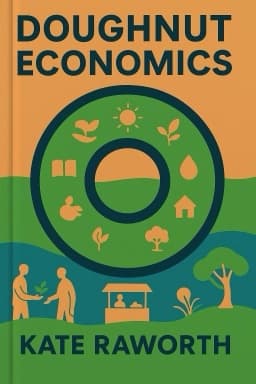
The Hidden Flaws of Traditional Economics: How Doughnut Economics Changes Everything
Unpacking the blind spots of classical economics and revealing a new paradigm for inclusive and sustainable prosperity.

Why Traditional Economics Falls Short
For decades, mainstream economics has relied on models that assume rational individuals acting in isolated markets, seeking to maximize utility and profits.
One glaring omission is the environment. Economic models rarely account for the depletion of natural capital or the costs of pollution. This omission has led to policies that prioritize growth at the expense of planetary health.
The Economy is Embedded, Not Separate
Doughnut Economics reframes the economy as embedded within the living biosphere and social fabric. It recognizes four realms of provisioning: households, markets, commons, and the state, each playing essential roles.
Human Nature: Beyond Self-Interest
Traditional economics depicts humans as selfish calculators, but behavioral research reveals a richer picture. People are social, influenced by norms, and motivated by more than money.
Systems Thinking: Embracing Complexity
Economies are complex adaptive systems with feedback loops and emergent properties. Linear cause-effect thinking fails to capture this dynamism, leading to policy failures.
Fair Distribution and Regeneration
Inequality is a product of economic design, not destiny. Wealth includes land, technology, and money creation power. Economies must be designed to distribute these fairly and regenerate natural systems through circularity and biomimicry.
Conclusion
Doughnut Economics challenges us to rethink deeply held assumptions and offers a holistic, hopeful framework for the future. It invites economists, policymakers, and citizens to work together to create economies that nurture people and planet alike.
Want to explore more insights from this book?
Read the full book summary