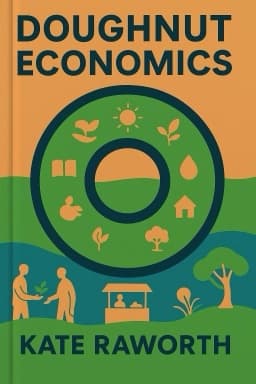
Kate Raworth
A transformative economic framework balancing human well-being and planetary limits for sustainable prosperity.
The concept of the Doughnut was inspired by a simple sketch drawn by Kate Raworth in 2011.
Section 1
7 Sections
Imagine a world where the measure of success is not how much we produce, but whether everyone has enough to live a dignified life within the limits of our planet.
GDP does not count unpaid work such as caregiving, which sustains families and communities. It ignores the depletion of natural resources and the pollution we create. It says nothing about how wealth is distributed or whether people have access to clean water, education, or political voice.
Scientists have identified nine planetary boundaries – thresholds in Earth’s systems like climate stability, biodiversity, and nitrogen cycles – which if crossed, threaten the stability of the environment that supports all life.
The Doughnut model visualizes a safe and just space for humanity: the inner ring sets out the social foundation – the essentials no one should fall below, such as food, water, health, and equity. The outer ring marks the ecological ceiling – the limits we must not exceed to maintain Earth’s stability. The space between is the Doughnut itself, where human prosperity and ecological sustainability meet.
Consider this: while billions have gained access to clean water and education over the last decades, billions still live in deprivation, and simultaneously, we have transgressed critical planetary boundaries. For example, carbon dioxide levels have risen beyond safe limits, threatening catastrophic climate change. Synthetic fertilizers are overused, polluting waterways and causing dead zones in oceans. Forest cover is shrinking, and biodiversity loss is accelerating.
What if instead of chasing endless growth, we aimed to bring everyone into the Doughnut’s safe and just space? What if progress meant thriving in balance, not moving endlessly forward and upward? This shift calls for new metaphors and new metrics – ones that capture the quality of life and the health of our planet.
As we embark on this journey, we must understand that the economy is not an isolated machine but part of a living system that includes society and nature. This realization leads us to the next insight: seeing the economy embedded within the broader web of life and human relationships.
What is the main criticism of GDP as a measure of progress?
13 more quizzes available in app
GDP is an incomplete and misleading indicator of human progress.
6 more insights available in app
Unlock all 7 sections, 7 insights, full audio, and interactive mind map in the SnapBooks app.
Discover the revolutionary economic model challenging GDP obsession and offering a blueprint for a thriving, fair, and sustainable future.
Read articleUnpacking the blind spots of classical economics and revealing a new paradigm for inclusive and sustainable prosperity.
Read article
Roger Bootle
Raghuram Rajan
Nouriel Roubini
Mariana Mazzucato
