
Why GDP is Dead: The Radical New Economics That Could Save Our Planet
Discover the revolutionary economic model challenging GDP obsession and offering a blueprint for a thriving, fair, and sustainable future.

Rethinking Progress Beyond GDP
Gross Domestic Product (GDP) has long been the yardstick by which nations measure their economic success. Yet, the relentless pursuit of GDP growth has blinded policymakers and citizens to the mounting crises of inequality, environmental degradation, and social instability.
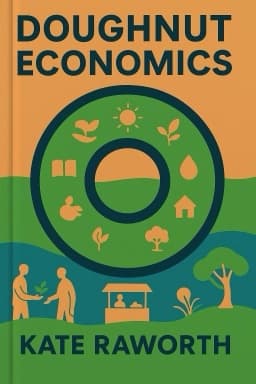
Enter Doughnut Economics, a framework that visualizes a 'safe and just space' for humanity. The inner ring represents the social foundation — essentials like food, water, housing, education, and equity that no one should fall below. The outer ring marks the ecological ceiling — planetary boundaries such as climate stability, biodiversity, and clean air that we must not overshoot. The space between these rings is the Doughnut itself, where human well-being and planetary health coexist in balance.
This model exposes how traditional economics, obsessed with growth, often ignores the invisible costs borne by the environment and marginalized communities. For example, GDP growth may rise while carbon emissions surge and millions remain in poverty.
The Economy Embedded in Society and Nature
Traditional economic models depict the economy as a closed loop of money flowing between households and firms, but this view omits the crucial role of energy, materials, and social relationships.
Four realms of provisioning sustain economic life: households (including unpaid care work), markets, commons (shared resources managed collectively), and the state. Recognizing these realms expands our understanding beyond market transactions and highlights the importance of social and ecological systems underpinning economic activity.
Human Nature: Beyond the Rational Economic Man
Economics has traditionally assumed individuals are rational, self-interested, and isolated decision-makers. However, behavioral science reveals humans are social, emotional, and adaptable beings influenced by norms and values.
Systems Thinking: The Economy as a Living System
The economy is not a static machine but a complex, dynamic system with feedback loops, tipping points, and emergent behaviors. This complexity explains phenomena like financial crises and environmental collapse that equilibrium models fail to capture.
Designing for Fair Distribution and Regeneration
Inequality is not inevitable but a design failure. Wealth includes not only income but control over land, technology, and money creation. Designing inclusive institutions and redistributing these assets is crucial for justice. Moreover, economies must shift from linear, extractive models to regenerative ones that restore ecosystems and promote circular resource use.
Becoming Growth-Agnostic
The fixation on growth overlooks ecological limits and social well-being. Post-growth economics propose steady-state and degrowth approaches prioritizing resilience and quality of life.
Conclusion: Redrawing the World with a Pencil
Economics is a human invention, and like any invention, it can be redesigned. The Doughnut Economics framework offers a hopeful, practical vision for transforming our economies to serve people and planet.
Explore this transformative journey and join the movement to rethink economics for the 21st century.
Want to explore more insights from this book?
Read the full book summary