
5 Mind-Blowing Lessons from Foundation’s Fear That Will Change How You See the Future
Discover the Hidden Wisdom and Revolutionary Ideas in Gregory Benford’s Visionary Continuation of Asimov’s Universe

1. The Audacity of Psychohistory: Predicting the Unpredictable
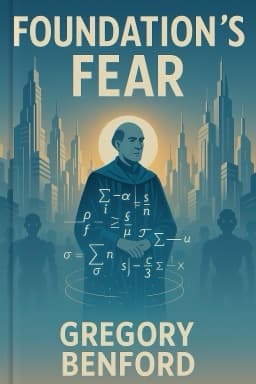
Imagine a future where the rise and fall of empires can be traced on a graph, and the fate of entire civilizations can be forecasted with mathematical precision. Gregory Benford’s Foundation’s Fear reintroduces us to Hari Seldon, the reluctant genius whose vision for psychohistory—part science, part art—forms the backbone of the Foundation universe. The novel vividly portrays Seldon’s struggle to transform his theory into a practical tool, highlighting the tension between determinism and chaos. His journey is fraught with skepticism, political resistance, and the daunting realization that human behavior, with its myriad passions and irrationalities, is the ultimate variable. Yet, Seldon’s perseverance teaches us that even the grandest visions begin with a single, persistent question: can we understand the patterns that shape our destiny?
2. Power, Politics, and the Machinery of Empire
Benford’s Trantor is more than a backdrop; it’s a living, breathing character. With over forty billion inhabitants, the city-planet is a microcosm of ambition, bureaucracy, and social stratification. The political intrigue is palpable as marginalized groups, like the Dahlites, fight for representation in the High Council, mirroring real-world struggles for equity and justice. The narrative explores how power is both a magnet and a burden, and how systems can ossify, becoming resistant to the very change they need to survive. Through Seldon’s eyes, we see that leadership requires more than vision; it demands empathy, adaptability, and the courage to challenge tradition.
3. The Beauty and Limits of Mathematics
At the heart of Foundation’s Fear is a profound meditation on mathematics as both a tool and a source of wonder. Seldon and his protégé, Yugo Amaryl, treat math as a living art—capable of revealing the hidden rhythms of history, yet always constrained by the unpredictability of individuals. Their breakthroughs and frustrations echo the real-world challenges of modeling complex systems, from economics to climate science. The lesson is clear: while numbers can illuminate, they can never capture the full richness of human experience. The pursuit of understanding, however, is itself a form of hope.
4. Of Robots and Taboos: The Ethics of Artificial Intelligence
Robots in the Empire are not celebrated but feared—outlaws living in the shadows, guided by the Zeroth Law to protect humanity as a whole, even at personal cost. Dors Vanabili and R. Daneel Olivaw embody the paradox of artificial intelligence: capable of deep empathy and loyalty, yet forever outsiders. Their secret interventions shape the fate of empires, raising profound ethical questions about trust, autonomy, and the boundaries between human and machine. Benford’s narrative reminds us that progress often comes from those who stand apart, and that the greatest advances are born from the courage to care, even when it is forbidden.
5. Faith, Reason, and the Healing Power of Knowledge
One of the novel’s most striking innovations is its use of AI simulations of Joan of Arc and Voltaire, whose debates bring to life the timeless tension between faith and reason. These dialogues, both playful and profound, help Seldon and his team refine psychohistory, ensuring that it accounts for the full spectrum of human motivation. The ultimate message is one of healing: knowledge is not merely for prediction or control, but for understanding, compassion, and renewal. The legacy of Seldon—and of the Foundation itself—lies in the hope that, together, we can build a future worth living.
Conclusion: Why Foundation’s Fear Still Matters
Foundation’s Fear is more than a continuation of Asimov’s legacy; it is a meditation on the possibilities and perils of knowledge, leadership, and progress. Its lessons resonate today, urging us to embrace both the rigor of science and the wisdom of compassion as we confront our own uncertain future.
Ready to dive deeper? Share your thoughts below and join the conversation about the future of humanity!
Want to explore more insights from this book?
Read the full book summary