
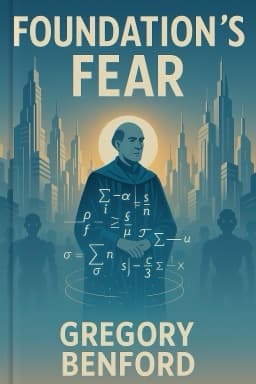
Why Foundation’s Fear Is the Most Underrated Sci-Fi Sequel of the Century
A Deep Dive into What Makes Gregory Benford’s Take on Asimov’s Universe So Bold, Brilliant, and Overlooked

When Gregory Benford took on the daunting task of continuing Isaac Asimov’s Foundation saga, expectations were sky-high—and perhaps that’s why Foundation’s Fear is so often overlooked. Yet, for those who venture into its pages, the novel offers a treasure trove of ideas, characters, and daring narrative risks. Benford’s Seldon is not the unflappable mastermind of legend, but a vulnerable, conflicted, and deeply human figure. This makes his quest to birth psychohistory all the more compelling and relatable.
One of the novel’s boldest moves is its expansion of psychohistory—not just as a science, but as a philosophy that grapples with the unpredictability of individuals and the moral weight of leadership. Benford doesn’t shy away from the messiness of politics, showing how power is negotiated, lost, and reclaimed in the Empire’s labyrinthine halls. The depiction of Trantor as a city-planet teetering on the edge of collapse is both a warning and a call to action, mirroring the fragility of our own institutions.
The novel’s treatment of robots—especially Dors Vanabili and R. Daneel Olivaw—adds a layer of ethical complexity rarely seen in mainstream science fiction. Their secret guardianship, governed by the Zeroth Law, raises questions about free will, trust, and what it means to be human. Benford’s willingness to let these themes play out in ambiguous, sometimes uncomfortable ways is a testament to his respect for the reader’s intelligence.
Perhaps the most underrated aspect of Foundation’s Fear is its philosophical ambition. The simulated debates between Joan of Arc and Voltaire are more than clever set pieces—they are the soul of the novel, inviting readers to wrestle with the eternal dance of faith and reason. These dialogues are not just intellectual exercises, but living arguments that shape the very fabric of psychohistory.
Critics may point to the novel’s complexity or its slower pace compared to Asimov’s originals, but these are strengths, not weaknesses. Foundation’s Fear asks us to think deeply, to question assumptions, and to see the future as a canvas painted with both hope and uncertainty. For anyone willing to engage with its ideas, it is a sequel that not only honors Asimov’s legacy but expands it in bold and necessary ways.
Don’t let this gem pass you by—read it, and discover why the future of science fiction is brighter than ever.
Want to explore more insights from this book?
Read the full book summary