
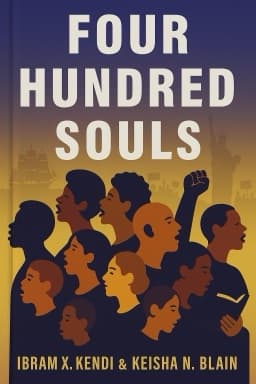
Why 'Four Hundred Souls' Will Change How You See American History Forever
A sweeping, soulful journey through 400 years of Black resilience and hope.

A sweeping, soulful journey through 400 years of Black resilience and hope
Imagine opening a book and hearing not one voice, but a chorus—each voice distinct, yet all harmonizing to tell the story of a people’s journey across four centuries. That’s the experience of reading Four Hundred Souls, a landmark work edited by Ibram X. Kendi and Keisha N. Blain. This book is not a dry recitation of dates and events; it is a living tapestry, woven from the threads of eighty essays and ten poems, each illuminating a five-year span in African American history. The result is a history that is as much felt as it is learned.
From the very first essay, you are transported to 1619, where the first Africans arrived in Virginia, stripped of their names and histories but not their humanity. Each subsequent essay, written by historians, journalists, activists, and artists, brings new perspective, new pain, new triumph. You’ll read about the invention of race in colonial law, the everyday heroism of enslaved people, the hope and heartbreak of emancipation, the creative explosion of the Harlem Renaissance, and the ongoing fight for justice in the era of Black Lives Matter.
The book’s structure—short, accessible essays—makes it perfect for both deep study and casual reading. Each essay stands alone, yet together they form a powerful narrative arc. At the end of every forty-year section, a poem offers a moment of reflection and healing, reminding us that history is not just about what happened, but how it is remembered and felt.
What sets Four Hundred Souls apart is its insistence on community. This is not the story of a single hero or a single tragedy, but of a people—each essayist adding their own verse to the song of survival and hope. The book’s diversity of contributors ensures that no single perspective dominates, and the result is a history that is both deeply personal and universally relevant.
For educators, this book is a treasure trove of teaching moments. For readers, it’s an invitation to empathy and understanding. And for America, it’s a mirror—sometimes painful, always necessary—reflecting the nation’s soul in all its complexity. Four Hundred Souls will change how you see American history, and perhaps, how you see yourself within it.
Ready to join the choir? This is one history lesson you won’t forget. 1 2 3
Want to explore more insights from this book?
Read the full book summary