
How ‘The Straight Mind’ Exposes the Hidden Rules of Gender and Desire
A Deep Dive Into the Invisible Systems That Shape Our Identities

A Deep Dive Into the Invisible Systems That Shape Our Identities
Gender and desire are often treated as natural givens, but Monique Wittig’s The Straight Mind reveals them as intricate social constructions governed by invisible yet powerful rules. These rules, embedded in language, law, and culture, enforce a compulsory heterosexuality that shapes who we are and how we relate to others.
Central to Wittig’s thesis is the idea that sex itself is a political category, not a biological fact. Scientific discourses that claim to describe 'natural' sex differences actually produce and reinforce a binary system aligned with heterosexual norms. This system polices bodies and desires, marginalizing those who deviate from the expected gender scripts.
The incest taboo, a prohibition deeply analyzed in psychoanalytic and structuralist traditions, functions as a cornerstone of this regulatory regime. It enforces clear boundaries of kinship, gender, and desire, sustaining the heterosexual matrix. However, queer identities and practices, by existing outside or against this matrix, expose its constructedness and open cracks in its foundation.
Drag performance serves as a powerful example of gender’s theatricality. By exaggerating and parodying gendered behaviors, drag reveals how gender is a stylized repetition rather than an innate essence. This performance disrupts the naturalized view of gender, offering a space for subversion and political resistance.
Wittig also challenges the notion of a unified feminist subject. The category 'women' is fragmented by intersecting identities and exclusions, requiring feminism to embrace multiplicity and fluidity rather than essentialism. This recognition is vital for building coalitions and political strategies that reflect lived realities.
Ultimately, The Straight Mind invites us to rethink identity and agency within power structures. Agency is not a pure force outside power but emerges through interrupting and transforming the systems that shape us. This nuanced understanding fosters a politics that is both critical and hopeful, grounded in complexity and inclusivity.
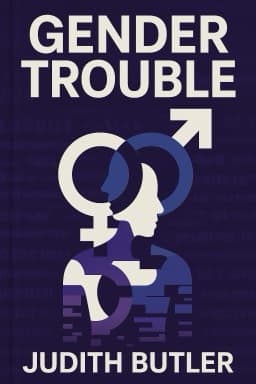
By exposing the hidden rules of gender and desire, Wittig’s work continues to inspire scholars, activists, and anyone interested in the radical possibilities of gender trouble.
Sources: Arts Faculty HKU, DePauw University, Wikipedia, Trivia Voices 1 2 3 4
Want to explore more insights from this book?
Read the full book summary