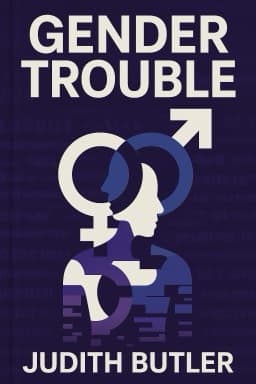
Judith Butler
A seminal work that redefines gender as a performative, socially constructed identity, challenging traditional feminist and cultural norms.
Gender Trouble is considered one of the foundational texts of queer theory.
Section 1
7 Sections
In the opening of our journey, we confront a question that is deceptively simple yet profoundly complex: who exactly are 'women' within feminist discourse? This is not merely a semantic inquiry but a political and philosophical challenge. The category 'women' has often been assumed as a stable, universal subject of feminism, a collective identity that unites all those who share a gendered experience. But this assumption is fraught with difficulties. Power structures, particularly legal and political systems, do not simply represent subjects; they actively produce them.
Consider the juridical system as a gatekeeper that defines the boundaries of subjectivity. It demands certain qualifications, often unspoken, that individuals must meet to gain recognition and representation. These qualifications are deeply embedded within gender norms, racial hierarchies, and class structures. As a result, many who identify as women find themselves excluded from the feminist subject, marginalized by the very systems that claim to empower them.
Moreover, the category 'women' is not monolithic. Intersectionality reveals that gender intersects with race, ethnicity, class, sexuality, and other axes of identity, creating a multiplicity of experiences that resist simple unification.
Representation, while necessary for political visibility, can paradoxically reinforce exclusion. By demanding a stable subject for representation, feminism risks naturalizing normative identities and silencing those who do not conform. Strategic uses of identity categories may serve short-term political goals but carry unintended consequences, perpetuating hierarchies within feminist movements.
Throughout this section, examples abound of groups historically excluded from feminist discourse—women of color, queer women, working-class women—whose experiences complicate the notion of a singular feminist subject. The story is not just about inclusion but about the very conditions that make inclusion possible or impossible.
As we close this first chapter of our exploration, we recognize that feminism must grapple with the constructedness of its own subject. It must question the stability of 'women' and embrace multiplicity and fragmentation as political realities rather than obstacles. This reflection sets the stage for our next inquiry into how sex, gender, and desire are ordered and regulated within societal frameworks, revealing the compulsory nature of normative gender relations.
What does the juridical system do in relation to feminist subjects?
13 more quizzes available in app
The feminist subject 'woman' is not a fixed identity but a product of legal, political, and linguistic practices that include and exclude.
8 more insights available in app
Unlock all 7 sections, 9 insights, full audio, and interactive mind map in the SnapBooks app.
Unlocking the Radical Insights That Challenge Everything You Thought About Gender
Read articleA Deep Dive Into the Invisible Systems That Shape Our Identities
Read article