
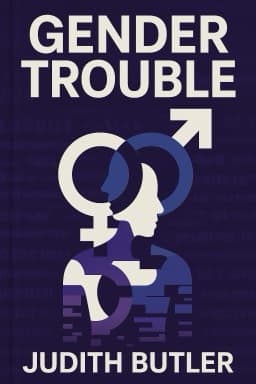
Why ‘The Straight Mind’ Will Change How You See Gender Forever
Unlocking the Radical Insights That Challenge Everything You Thought About Gender

Unlocking the Radical Insights That Challenge Everything You Thought About Gender
In a world where gender often feels like an immutable fact, Monique Wittig’s The Straight Mind shatters this illusion with a radical clarity that continues to reverberate through feminist and queer theory today. This collection of essays, first published in the early 1990s, challenges the very foundations of how we understand sex, gender, and desire. Wittig’s incisive critique reveals that these categories are not natural or biological givens but rather political and linguistic constructs maintained by what she calls the 'straight mind'—the dominant heteronormative worldview that enforces compulsory heterosexuality.
At the heart of Wittig’s argument is the destabilization of the category 'woman.' Far from being a stable, universal identity, 'woman' is shown to be a construct produced by legal, social, and linguistic systems that include some bodies and exclude others. This exclusion is not accidental but central to how gender operates as a system of power. Wittig’s work reveals that the feminist subject is itself a product of these power relations, highlighting the fractures and exclusions within feminist movements that fail to account for intersecting identities such as race, class, and sexuality.
One of the most compelling aspects of The Straight Mind is its exploration of how sex itself is constructed. Contrary to popular belief, sex is not a purely biological category but a political one, produced through scientific and cultural discourses that serve to uphold the gender binary and compulsory heterosexuality. Wittig emphasizes the 'heterosexual matrix'—a system that polices bodies and desires to conform to rigid binaries, marginalizing those who fall outside its bounds.
Wittig’s use of psychoanalytic and structuralist theory further deepens this analysis. The incest taboo, for example, is not just a familial prohibition but a key mechanism enforcing gender binaries and heterosexual desire. Homosexuality, in contrast, disrupts this system by challenging the coherence of compulsory heterosexuality, exposing the constructed nature of gender norms.
Through examples such as drag performance, Wittig illustrates gender as a performative act—a stylized repetition of behaviors that create the illusion of a stable identity. Drag exaggerates gender traits to expose their theatricality and artificiality, opening possibilities for subversion and transformation. This performativity reveals that gender is not something one is, but something one does, repeatedly.
Politically, Wittig argues that agency emerges not from purity or separation from power but from engaging within power structures to interrupt and reverse them. This 'impurity' of political positions allows for nuanced activism that embraces complexity and coalitional potential. Extending legitimacy to marginalized identities deemed 'unreal' by normative standards challenges violent ideal morphologies and opens space for inclusive, livable lives.
In sum, The Straight Mind is a profound call to rethink gender, identity, and politics. It invites us to embrace multiplicity, fluidity, and performativity as tools for liberation and transformation. Wittig’s work remains a vital resource for anyone seeking to understand and challenge the deeply entrenched norms that shape our lives.
For readers eager to explore the frontiers of feminist and queer thought, Wittig’s essays offer both a critical lens and a hopeful vision—a reminder that gender trouble is not just a disruption but a possibility for creating new worlds.
Explore more about how these ideas unfold and their continuing relevance in contemporary debates about gender and sexuality.
Sources: Arts Faculty HKU, DePauw University, Wikipedia, Trivia Voices 1 2 3 4
Want to explore more insights from this book?
Read the full book summary