
Unlocking Madness: The Hidden History That Will Change How You See Sanity Forever
How Madness Shaped Western Society and Our Understanding of Sanity

Madness has long been a subject shrouded in mystery, fear, and misunderstanding. But what if the way we have understood madness throughout history is less about the medical realities and more about society's shifting boundaries of reason and exclusion? Michel Foucault’s groundbreaking work, Madness and Civilization, offers a profound exploration of this question, tracing the cultural, social, and institutional evolution of madness in Western society.
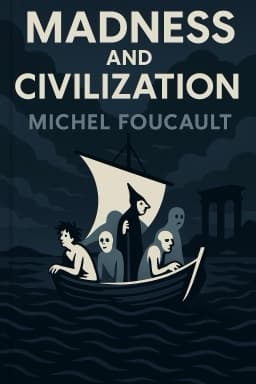
Foucault begins his journey in the Middle Ages, where madness was intertwined with the social exclusion of lepers. As leprosy mysteriously receded from Europe between the 14th and 17th centuries, the vast networks of lazar houses emptied, leaving behind not just abandoned buildings but a vacuum in the social imagination. This void was soon filled by madness, which inherited the stigma, isolation, and fear once reserved for the leper. The mad were literally cast adrift on ships — the famous 'Ship of Fools' — symbolizing their liminal status between society and exile. These ships, floating prisons on rivers and seas, embodied society’s ambivalence: madness was both a threat to be removed and a spectacle to be observed.
As Europe transitioned into the early modern period, the Great Confinement emerged. Institutions like the Hopital General in Paris confined nearly one percent of the population, including the poor, idle, and mad. These were not hospitals in the modern sense but administrative complexes blending policing, charity, and punishment. Begging was criminalized, and forced labor became a moral imperative, reflecting a new social ethic that equated idleness with sin and danger. The mad were housed alongside criminals and paupers, blurring distinctions and emphasizing control over care.
Within these walls, madness occupied a paradoxical space. The insane were hidden to avoid scandal yet displayed as curiosities for public amusement. Chains and cages reinforced their perceived animality, while stories of their extraordinary endurance fed myths of otherness. Madness was both shame and spectacle — a social performance that reflected society’s deep ambivalence.
But madness was also an intensely personal experience, rooted in the passionate disturbance of the unity between body and soul. Delirium, the language of madness, combined vivid hallucinations with false but internally consistent reasoning. This complex inner world challenged simplistic views of madness as mere error or disease, revealing it as a profound human condition at the limits of reason.
The birth of the asylum marked a turning point. Moving away from chains and cages, moral treatment emphasized work, religious instruction, and constant surveillance. Madness became a medical object, observed and classified, laying the foundation for modern psychiatry. Yet this medicalization was inseparable from power — institutions wielded knowledge to define sanity and enforce social order.
Madness functioned as a mirror reflecting societal fears and anxieties. It defined cultural boundaries, marking what was excluded to maintain order. Fear drove exclusionary practices, reinforcing stigma and marginalization. The politics of madness revealed how knowledge and law intertwined to control and confine, from royal edicts to psychiatric classifications.
Today, recognizing madness as part of human diversity invites us to move beyond fear and exclusion. Understanding its history fosters empathy, challenges stigma, and opens paths to more compassionate care. Madness is no longer just a mark of shame but a facet of humanity worthy of respect.
Through this journey, Foucault invites us to reconsider our assumptions about sanity and madness, urging a deeper reflection on how societies define and treat difference. The history of madness is not just a tale of confinement and fear but also a story of hope and transformation.
To truly understand madness, we must see it as a complex interplay of history, culture, and human experience — a mirror reflecting the limits and possibilities of reason itself.
Sources: SparkNotes summary, SuperSummary analysis, Wikipedia entry on Madness and Civilization 1 3 4
Want to explore more insights from this book?
Read the full book summary