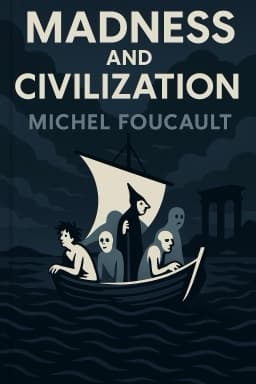
Michel Foucault
A seminal historical and philosophical study of how Western society has defined, excluded, and treated madness from the Middle Ages to the modern asylum.
Michel Foucault originally trained as a philosopher and historian before becoming a leading figure in social theory and critical studies of psychiatry.
Section 1
8 Sections
Imagine a world where entire communities are defined by fear and exclusion, where the sick are cast out to the edges of society. In medieval Europe, leprosy was not just a disease but a social sentence. Tens of thousands of lazar houses dotted the continent, serving as both hospitals and places of exile. These were spaces where the leper was both visible and invisible — shunned yet a constant reminder of divine wrath and mercy.
As lepers vanished, madness stepped into the role of the ultimate outsider. The mad were no longer merely individuals suffering from unreason but became the new figures of exclusion, inheriting the stigma, the isolation, and the fear that once belonged to lepers. This transition was neither simple nor immediate, but it was profound. The physical spaces once dedicated to the sick were repurposed, and the moral values attached to exclusion were transferred.
One of the most haunting symbols of this period is the 'Ship of Fools.' These were not just metaphors but real vessels that carried madmen away from cities, sometimes wandering the rivers and seas for weeks.
Art and literature of the Renaissance captured this ambivalence. Paintings depicted these ships laden with mad souls, while satirical poems and plays gave voice to folly as both a tragic and comic force. Madness was no longer confined to the margins of the mind; it was a social phenomenon, a shared concern, and a source of fascination and fear.
But why did society choose water and navigation as the medium of madness’s exile? Water symbolized the unknown, the uncontrollable, and the boundary between life and death. To cast madmen upon the waves was to place them in the hands of fate, to mark them as passengers between worlds, neither fully here nor there.
From the empty lazar houses to the drifting ships, this chapter of history reveals how madness was woven into the fabric of social exclusion. It was not merely a medical or psychological condition but a cultural and moral category, deeply embedded in the fears and hopes of a society grappling with its own limits.
As we move forward, we will see how this exclusion took new forms, how madness became confined not just physically but conceptually, and how the great institutions of confinement arose to contain not only bodies but also meanings. Let us set sail from the shadows of exclusion into the age of confinement.
What social group’s exclusion created the ‘vacant spaces’ later occupied by madmen?
15 more quizzes available in app
Madness took over the social stigma and exclusion previously attached to leprosy.
7 more insights available in app
Unlock all 8 sections, 8 insights, full audio, and interactive mind map in the SnapBooks app.
How Madness Shaped Western Society and Our Understanding of Sanity
Read articleHow Society’s Fear of Madness Created the Institutions We Know Today
Read article