
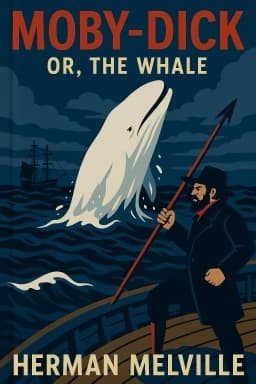
Why Moby-Dick Is More Than Just a Whale Story: The Obsession That Haunts Us All
Dive deep into the swirling seas of obsession, fate, and identity in Melville’s masterpiece.

At first glance, Herman Melville's Moby-Dick might seem like a straightforward tale of a whaling voyage, a man hunting a monstrous whale. But beneath the surface lies a vast ocean of themes and symbolism that explore the deepest corners of the human psyche. The story is not just about a whale; it's about obsession, fate, identity, and the eternal struggle between man and the unknowable forces of nature.
Captain Ahab’s obsession with the white whale, Moby Dick, is the novel’s beating heart. His relentless pursuit is a metaphor for monomania — a fixation so intense it consumes his entire being, blinding him to reason and endangering everyone aboard the Pequod. His wooden peg leg, a constant reminder of his past battle with the whale, symbolizes the deep psychological wound fueling his vengeance. This obsession illustrates a universal human condition: the dangerous allure of revenge and the self-destructive power of single-mindedness.
But the novel is not just about Ahab. The Pequod itself serves as a floating microcosm of humanity, with a diverse crew representing different cultures, races, and social backgrounds. Their interactions mirror the complexities and tensions of society at large, highlighting themes of unity amid diversity and the fragile bonds forged in adversity. The friendship between Ishmael, the narrator, and Queequeg, a tattooed harpooner from a distant island, breaks cultural barriers and symbolizes the possibility of connection beyond prejudice.
Central to Moby-Dick is the enigmatic symbolism of the white whale itself. Its whiteness embodies paradox, representing both purity and terror, the known and the unknowable. This duality reflects the existential fears that haunt humanity — the vast, indifferent universe that defies understanding. The whale is not just an animal but a living symbol of the mysteries and ambiguities of life.
The novel also invites profound philosophical reflections on identity and mortality. The motif of masks reveals how people hide their true selves behind social roles and conventions, while meditations on death underscore the fragility and impermanence of life. Through these layers, Melville crafts a narrative that is as much about inner journeys as it is about the physical voyage.
Storms and omens throughout the voyage serve as powerful metaphors for fate and the uncontrollable forces that shape human destiny. The sea itself becomes a character — unpredictable, merciless, and awe-inspiring — reminding us of our vulnerability and the limits of human control.
In the end, the Pequod’s destruction and Ishmael’s solitary survival symbolize the enduring human spirit amid catastrophe. Clinging to a coffin-shaped life buoy, Ishmael becomes the witness and storyteller, carrying forward the legacy of the voyage and its lessons.
Moby-Dick is far more than a tale of whaling; it is a timeless meditation on obsession, identity, and the human condition. Its rich symbolism and profound themes continue to resonate, inviting each generation to confront their own white whales and the depths of their souls.
For readers seeking a story that challenges and transforms, Moby-Dick offers a voyage unlike any other.
Sources: Fiveable Library on Melville's themes 1 , LitCharts on symbolism 2 , StudySmarter summary 3
Want to explore more insights from this book?
Read the full book summary