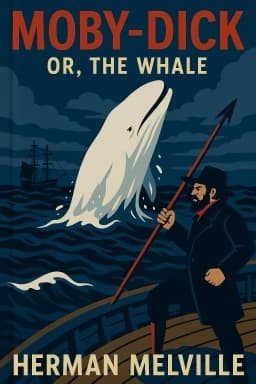
Herman Melville
An epic tale of obsession and adventure as Captain Ahab relentlessly hunts the enigmatic white whale, Moby Dick.
Melville dedicated Moby-Dick to Nathaniel Hawthorne, whose friendship deeply influenced him.
2 more facts available in the app
Section 1
9 Sections
There is a profound moment when a man, weighed down by the invisible burdens of his spirit, finds himself drawn irresistibly toward the vast, untamed ocean. This is no mere physical journey; it is a pilgrimage of the soul. Imagine standing on the bustling piers of an old city, the cold wind biting at your face, and the sea stretching endlessly before you. Around you, crowds gather—some leaning on railings, others perched atop ships’ rigging—all gazing out, as if seeking answers in the rolling waves.
As he prepares, Ishmael reveals his pragmatic nature. He is no captain or officer, but a simple sailor, one who embraces the hardships and humility of life at sea. This choice reflects a shedding of social pretensions and a willingness to confront the rawness of existence.
In the midst of this, Ishmael’s reflections on the human connection to water resonate deeply. Across cultures and ages, water has been revered as sacred, a source of life and transformation. The sea’s vastness mirrors the infinite complexities of the human psyche, its depths hiding both wonders and terrors.
As the ship sets sail and the city fades behind, the reader is invited to embark on a voyage not just across oceans, but into the heart of human experience itself. The next chapter awaits, where the crew assembles and the true nature of this voyage begins to unfold.
What emotional state motivates Ishmael to go to sea?
17 more quizzes available in app
The sea represents both a physical and spiritual refuge from the trials of life.
8 more insights available in app
Unlock all 9 sections, 9 insights, full audio, and interactive mind map in the SnapBooks app.
Dive deep into the swirling seas of obsession, fate, and identity in Melville’s masterpiece.
Read articleExplore the layers of meaning behind the white whale and Captain Ahab’s relentless chase.
Read article