
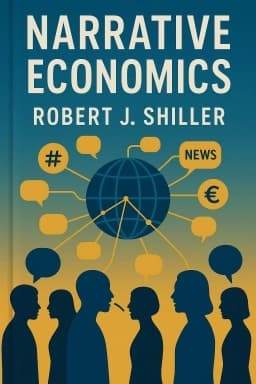
Why Stories Move Markets: The Hidden Power Behind Booms and Busts
How Contagious Stories Shape Our Economic Reality

How Contagious Stories Shape Our Economic Reality
Imagine the world’s financial markets as a vast ocean, with waves crashing and receding in unpredictable rhythms. Most economists once believed these waves were driven solely by the wind of real numbers—interest rates, employment data, or quarterly profits. But what if, beneath the surface, the true force stirring these waters was something far more human: the stories we tell each other? This is the provocative thesis of Nobel laureate Robert J. Shiller’s 'Narrative Economics,' a book that challenges everything you think you know about why markets boom and bust.
Shiller argues that economic events are not just the product of rational calculation or cold statistics. Instead, they are the outcome of viral narratives—stories that capture the imagination, spread like epidemics, and motivate millions to act in unison. Think about the dot-com bubble of the late 1990s: it wasn’t just about new technology, but about a collective belief in the limitless potential of the internet. Or the housing crash of 2008, fueled by the story that home prices could only go up. These narratives, once they reach a tipping point, can override logic and data, creating self-fulfilling prophecies and, sometimes, disasters.
Shiller’s insight draws on epidemiology: just as a virus spreads through a susceptible population, so too do economic stories. Some narratives are highly contagious, leaping from person to person through news headlines, social media, or even casual conversation. Others fade away, remembered only by a few. The most powerful stories are those that tap into deep emotions—fear, greed, hope, or nostalgia—and are often amplified by celebrities, influencers, or trusted authorities. In fact, Shiller shows that certain stories, like the fear of job-stealing robots or the promise of a new technological golden age, resurface again and again, mutating with each new generation but always retaining their core emotional appeal.
Consider the story of the gold standard, which has reappeared in economic debates for over a century. Each time financial uncertainty arises, the narrative returns, often with new details or celebrity endorsements. Or look at the recurring fear of automation: from the Luddites smashing looms in the 19th century to today’s anxieties about artificial intelligence, the story remains the same, even as the characters and technologies change. These recurring narratives shape not only individual decisions but also collective action, driving waves of investment, panic, or reform that can transform entire economies.
What makes a story go viral? Shiller identifies several key ingredients: emotional resonance, simplicity, strong visuals, and the endorsement of influential figures. Timing and randomness also play a role—a story that might have languished in obscurity can suddenly explode if it catches the attention of a super-spreader or coincides with a major event. Today, digital tools allow economists to track these narratives in real time, scanning news, social media, and search trends for emerging stories that could signal coming shifts in sentiment or behavior. This new approach offers the tantalizing possibility of forecasting crises and opportunities before they appear in the data.
Shiller’s message is ultimately optimistic: by taking stories seriously, we can better anticipate, understand, and shape the economic events that define our lives. He urges policymakers to become more mindful storytellers, crafting narratives that build trust and cooperation rather than division or fear. And he reminds all of us that, in the digital age, everyone is a potential storyteller, capable of influencing the course of history with the stories we choose to share.
So next time you see a market surge or a sudden panic, ask yourself: what story is spreading? And how might your own words become part of the next great economic narrative?
Want to explore more insights from this book?
Read the full book summary