
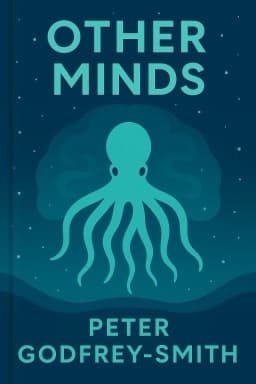
Unlocking Alien Minds: What Octopuses Teach Us About Consciousness
Dive into the mysterious world of octopus intelligence and discover how these sea creatures challenge our understanding of mind and consciousness.
Dive into the mysterious world of octopus intelligence and discover how these sea creatures challenge our understanding of mind and consciousness.
Imagine encountering a mind so different from our own that it feels almost alien. This is the experience scientists and philosophers face when studying octopuses and their cephalopod relatives. In Other Minds, Peter Godfrey-Smith takes us on a mesmerizing journey through the evolution of intelligence, tracing the path from the earliest nervous systems in ancient oceans to the remarkable minds of modern octopuses, squids, and cuttlefish.
Early life in the ocean was simple, with single-celled organisms capable of basic sensory-motor functions. Over time, multicellular animals developed primitive nervous systems—networks of neurons that coordinated movement and responses. The Cambrian explosion accelerated this complexity, leading to the emergence of eyes, predation, and behavioral intricacies.
Cephalopods took a bold evolutionary step by shedding their external shells, trading protection for agility and flexibility. This allowed them to evolve soft bodies with flexible arms lined with suckers, each arm containing more neurons than the central brain itself. This decentralized nervous system lets octopuses perform intricate tasks such as opening jars, manipulating objects, and even escaping enclosures through clever problem solving.
One of the most astonishing features of cephalopods is their skin, a living canvas capable of rapid color and texture changes. Despite being color blind, they control millions of chromatophores to create vivid displays for camouflage, communication, and expression. Recent discoveries reveal their skin contains light-sensitive molecules, allowing them to 'see' and respond to light independently of their eyes.
These color changes serve as a complex language, sometimes resembling grammar-like sequences used in social interactions. Yet, many patterns appear spontaneous, reflecting the animal’s internal emotional states, hinting at a form of self-expression.
Philosophically, cephalopods challenge our notions of consciousness. Their minds evolved through continuous sensory-motor feedback loops rather than sudden leaps. Their decentralized brains and unique body plans suggest that consciousness is not a singular phenomenon but a spectrum of experiences shaped by different architectures.
Octopuses also display social behaviors in rare underwater communities like Octopolis, where they interact through touch and displays, contradicting their usual solitary reputation. They recognize individual humans, engage in play, and exhibit distinct personalities, demonstrating cognitive flexibility and individuality.
Yet, these intelligent creatures live short lives, often just one or two years. This paradox is explained by evolutionary trade-offs between reproduction, survival, and brain maintenance. Their semelparous reproductive strategy—breeding once before death—reflects ecological pressures and high predation risks.
Finally, the ocean emerges as the cradle of mind, where the first flickers of subjective experience arose. Protecting marine ecosystems is not only vital for biodiversity but also for preserving the diversity of minds and consciousness on Earth.
Exploring octopus minds invites us to expand our understanding of intelligence beyond human-centric views, embracing the rich tapestry of consciousness woven throughout life’s evolutionary history.
Whether you are fascinated by biology, philosophy, or the mysteries of the mind, the story of cephalopods offers a captivating window into the origins and diversity of consciousness.
References: Goodreads, Amazon, Words and Dirt, LA Times 1 2 3 4
Want to explore more insights from this book?
Read the full book summary