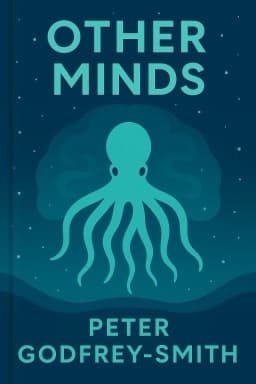
Peter Godfrey-Smith
An insightful exploration of cephalopod intelligence and the evolutionary origins of consciousness, blending science and philosophy.
Octopuses have about 500 million neurons, most located in their arms, enabling semi-independent arm control.
1 more facts available in the app
Section 1
10 Sections
Imagine the ancient seas, over 600 million years ago, where life was just beginning to take on the forms that would eventually lead to the incredible diversity we see today.
Before these multicellular animals, even single-celled organisms like bacteria had remarkable abilities to sense their environment. Take E. coli, for instance, which detects chemicals in its surroundings and moves accordingly, swimming toward nutrients and away from harmful substances.
As multicellularity emerged, cells began to work together, requiring new forms of communication and control.
Fast forward to the Cambrian period, around 542 million years ago, when life exploded in diversity.
These evolutionary changes set the stage for the emergence of intelligence and consciousness, but the journey was gradual, with many intermediate steps.
Let us now dive deeper into the world of these remarkable animals and explore how their intelligence and behaviors illuminate the mysteries of mind and life.
What is the earliest form of nervous system likely found in ancient animals?
19 more quizzes available in app
Nervous systems initially evolved to coordinate movement within multicellular organisms, not just to link sensory input to action.
8 more insights available in app
Unlock all 10 sections, 9 insights, full audio, and interactive mind map in the SnapBooks app.
Dive into the mysterious world of octopus intelligence and discover how these sea creatures challenge our understanding of mind and consciousness.
Read articleDiscover how octopuses evolved intelligence in a way that makes them seem like extraterrestrial beings living among us.
Read article