
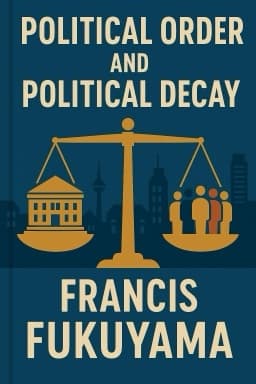
Why Political Order is Crumbling: The Shocking Truth About Democracy’s Fragility
Discover the hidden forces undermining modern democracies and what it means for our future.

Introduction: The Pillars That Hold Our Societies Together
Political order is the invisible architecture that shapes our daily lives, from the laws we follow to the leaders we elect. According to Francis Fukuyama, political order rests on three foundational pillars: the state, the rule of law, and accountability.
But what happens when these pillars weaken? Fukuyama introduces the concept of political decay — when institutions become rigid, corrupt, or disconnected from the people they serve. This decay is not exclusive to authoritarian regimes; even mature democracies like the United States face it in the form of legislative gridlock, elite capture, and eroding trust.
The Historical Journey: From Patrimonialism to Modern States
In the early days of political organization, rulers treated the state as their personal property, a system known as patrimonialism. Here, loyalty was rewarded with favors, and public office was an extension of the ruler’s household.
Technological advancements like railroads and the telegraph expanded state capacity, enabling governments to govern larger territories more effectively. However, rapid urbanization also led to clientelistic political machines that distributed resources in exchange for votes, illustrating the complex interplay between modernization and traditional political practices.
Reforming Governance: From Spoils to Service
The American experience of dismantling the spoils system through the Pendleton Act illustrates the struggle to build a professional civil service. The assassination of President Garfield by a disgruntled office seeker highlighted the dangers of patronage politics and galvanized reform efforts.
Bureaucratic autonomy, exemplified by agencies like the U.S. Forest Service, demonstrates how technical expertise combined with political skill can protect institutions from undue interference, enabling them to serve long-term public interests. Conversely, agencies lacking autonomy often falter under political pressures.
Nation Building and Identity: The Glue of Political Order
National identity is a powerful force that legitimizes political order. Through print capitalism — the spread of newspapers, books, and schools — diverse populations come to see themselves as part of a shared community.
The Dark Side: Political Decay and Its Manifestations
Political decay manifests as institutional rigidity, elite capture, and clientelism. Even democracies with multiple veto points, like the United States, experience gridlock that frustrates citizens and hampers effective governance. Interest groups and public-sector unions may resist reforms that threaten their privileges, perpetuating policy inertia.
Clientelism persists globally, providing political inclusion for marginalized groups but undermining meritocracy and accountability. Reform efforts often face opposition from beneficiaries of patronage networks, making change difficult.
Multiculturalism and the Challenge of Modern Nationhood
Modern states increasingly face the challenge of managing diverse identities. The state-nation model embraces multiple cultural groups within a single political framework, fostering inclusion and mitigating conflict.
Conclusion: Hope for Renewal
Political development is an ongoing process of balancing state power, rule of law, and accountability. While political decay poses serious threats, history shows that institutions can reform and renew through leadership, coalitions, and civic engagement.
Want to explore more insights from this book?
Read the full book summary