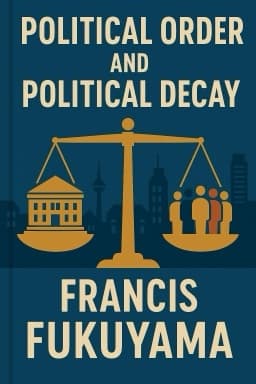
Francis Fukuyama
A detailed exploration of how political institutions develop, interact, and decline, emphasizing the balance of state power, rule of law, and democratic accountability.
Francis Fukuyama’s concept of 'getting to Denmark' symbolizes achieving a balanced, well-functioning political system.
2 more facts available in the app
Section 1
10 Sections
As we embark on this journey through the complex landscape of political order and decay, it is essential to understand the three pillars that uphold any political system: the state, the rule of law, and accountability. Imagine a grand fortress representing the state — a centralized, hierarchical institution wielding legitimate power over a defined territory. But this fortress alone is not enough. It must be balanced by the scales of justice, symbolizing the rule of law, where laws bind even the mightiest rulers. Without this, power becomes arbitrary, and tyranny may flourish. Alongside these stands a vibrant assembly of citizens, embodying accountability, the mechanism through which governments remain responsive to the broader community.
Early states were often indistinguishable from the ruler's household, a system known as patrimonialism. Here, loyalty was rewarded with favors, and public office was a private domain.
This contrasts sharply with the modern state's impersonality, where officials serve the public interest and are recruited on merit. The rule of law is not merely about order or property rights but about a binding consensus that even kings and presidents must respect. This is distinct from rule by law, where laws serve as instruments of the ruler’s will rather than constraints.
Accountability today is most often procedural — free and fair elections — but it also encompasses substantive responsiveness, where governments act in the public interest even without electoral mechanisms.
The balance among these institutions is delicate but vital. A state too powerful and unchecked becomes a dictatorship; too weak and fragmented, it becomes ineffective and unstable. This interplay sets the stage for the political narratives and transformations we will explore.
Let us now delve deeper into the forces that have shaped these institutions historically and how they continue to influence political development.
What distinguishes a modern state from an early patrimonial state?
19 more quizzes available in app
State, rule of law, and accountability form the foundation of political order.
8 more insights available in app
Unlock all 10 sections, 9 insights, full audio, and interactive mind map in the SnapBooks app.
Discover the hidden forces undermining modern democracies and what it means for our future.
Read articleUnmasking the enduring networks of power that shape politics beyond the ballot box.
Read article
Daron Acemoglu and James A. Robinson
David Cole

Victor Davis Hanson

Josh Rogin
