
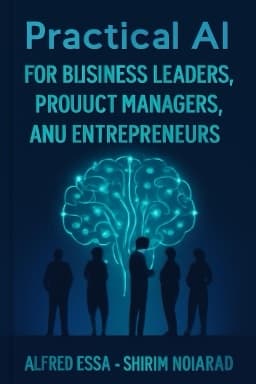
Unlocking the Secrets of AI: How This Book Transforms Your Understanding of Machine Learning
Dive deep into the foundations of AI and machine learning with clear explanations and real-world insights that will change how you see technology.

Dive deep into the foundations of AI and machine learning with clear explanations and real-world insights that will change how you see technology.
Artificial Intelligence (AI) is no longer a futuristic concept but a present-day reality reshaping industries and everyday life. Yet, the journey to truly understanding AI begins with grasping its origins and fundamental principles. This blog walks you through a rich narrative derived from a seminal book that unpacks AI’s evolution from symbolic logic to modern deep learning.
The story starts centuries ago, with a visionary idea that human reasoning could be mechanized by combining atomic symbolic concepts. This early vision set the stage for the development of computational machines and, eventually, AI systems. However, it soon became clear that machines face inherent limits — not every problem is computable — tempering early optimism and guiding realistic expectations.
Today’s AI largely manifests as narrow intelligence, excelling in specific tasks like image recognition or spam filtering, rather than a general intelligence capable of human-like cognition. Machine learning, a subset of AI, enables systems to learn patterns from data rather than relying on explicit programming, revolutionizing how we approach problem-solving.
One foundational model is simple linear regression, which predicts continuous outcomes using a single feature. Its elegance lies in interpretability — the slope quantifies how much the target changes per unit change in the feature. This model introduces core concepts like error quantification through Mean Squared Error (MSE) and explanatory power via R-squared. Understanding these metrics equips readers to evaluate model performance critically.
Transitioning from prediction to classification, the K-Nearest Neighbors (KNN) algorithm embodies an intuitive approach: classify a point based on its closest neighbors. The choice of neighbors (k) and distance metrics like Euclidean or Manhattan distance influence accuracy and robustness. This method’s simplicity belies its versatility, applicable in fraud detection, customer segmentation, and more.
Model assessment is a balancing act between underfitting and overfitting, captured by the bias-variance tradeoff. Underfitting misses important patterns; overfitting captures noise as if it were signal. Techniques like k-fold cross-validation help find the optimal complexity, ensuring models generalize well to new data.
Evaluation metrics extend beyond regression. Classification requires nuanced measures such as precision and recall, which balance correctness and completeness of positive predictions. ROC curves and AUC provide graphical and scalar summaries of classifier discrimination ability, crucial in domains like medical diagnosis where false negatives carry high costs.
Expanding predictive power, multiple linear regression incorporates several features, enabling richer models. Logistic regression adapts regression for classification by modeling probabilities via the sigmoid function, with coefficients interpretable as odds ratios — a powerful tool for business insights.
Unsupervised learning, exemplified by K-Means clustering, discovers hidden data structures without labels. By iteratively refining cluster centroids, it segments customers or patterns, guiding strategic decisions. Selecting the number of clusters (k) wisely is vital, using methods like the elbow or silhouette scores.
Finally, deep learning represents the cutting edge, with neural networks composed of layers of neurons applying weighted sums and nonlinear activations. Forward and backward propagation enable networks to learn complex, hierarchical representations, powering breakthroughs in image recognition, language understanding, and beyond.
This journey from symbolic logic to deep learning reveals AI’s layered complexity and transformative potential. By understanding foundational models, evaluation metrics, and advanced techniques, readers gain the insight necessary to harness AI responsibly and effectively.
Whether you’re a business leader, data scientist, or curious learner, this exploration offers a rich foundation to engage with AI’s promises and challenges. Embrace the knowledge, and let it guide your path in this exciting era of intelligent machines.
References: Qualtrics AI book list, 365 Data Science AI books, ACS Publications AI insights 1 , 2 , 4
Want to explore more insights from this book?
Read the full book summary