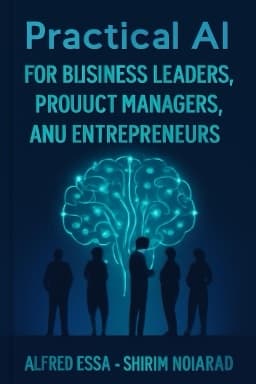
Alfred Essa and Shirin Mojarad
A practical, technical guide to AI and machine learning for business leaders, blending conceptual knowledge, theory, and Python practice.
The book breaks down complex AI concepts into three chapters per topic: concept, theory, and practice, making it accessible for non-technical readers.
Section 1
9 Sections
Imagine standing at the dawn of a revolution, where centuries-old dreams of mechanizing human thought begin to crystallize into reality. The journey of artificial intelligence is a tale that stretches back to the 17th century, when the great philosopher and mathematician envisioned a universal logical machine. This machine, he imagined, would operate by combining atomic symbolic concepts according to fixed rules, allowing it to resolve disputes by calculation alone.
Fast forward to the mid-20th century, where the dream took a more concrete form with the advent of computing machines. Yet, even then, pioneers understood that there are inherent limits to what machines can compute. Not every problem is solvable by algorithmic means.
Today, AI manifests predominantly as narrow AI, systems designed to perform specific tasks with remarkable efficiency—be it recognizing faces, filtering emails, or predicting financial fraud. This contrasts with the still-elusive general AI, which would possess the full intellectual capacity of humans.
At the core of narrow AI lies machine learning, a paradigm shift from traditional programming. Instead of explicitly coding every rule, machine learning algorithms derive patterns and rules from data, enabling them to improve over time. This approach is revolutionizing how businesses operate, powering innovations from recommendation engines to autonomous vehicles.
The process of building machine learning models is an iterative workflow: first, preparing and cleansing data; second, selecting an appropriate model type; third, fitting the model to data; fourth, evaluating its accuracy; and finally, deploying it for prediction. Each step is vital, and the cycle repeats as new data arrives and models evolve.
As we embark on this exploration, keep in mind that AI is not magic but a powerful tool grounded in logic, statistics, and computation. Its transformative potential hinges on our understanding and stewardship. With this foundation, we move forward into the world of machine learning models, starting with the simplest yet most powerful: simple linear regression.
Let us now delve into how a single continuous feature can predict a continuous outcome, unlocking insights into relationships hidden within data.
What did Leibniz envision as the basis for artificial intelligence?
17 more quizzes available in app
AI is a transformative technology akin to electricity or the steam engine, driving innovation across sectors.
8 more insights available in app
Unlock all 9 sections, 9 insights, full audio, and interactive mind map in the SnapBooks app.
Dive deep into the foundations of AI and machine learning with clear explanations and real-world insights that will change how you see technology.
Read articleLearn how to build, assess, and apply machine learning models that drive smarter business decisions and innovation.
Read article