
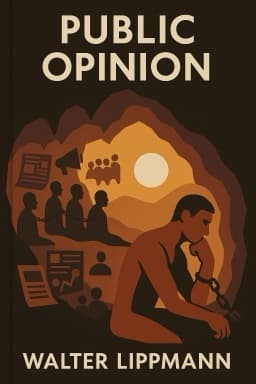
The Hidden Reality: How Our Minds Construct the World We Live In
Discover the invisible mental maps shaping our perceptions and decisions in a complex world.

Have you ever wondered why two people can witness the same event yet come away with completely different memories and opinions? Or why public opinion sometimes seems disconnected from the actual facts on the ground? Walter Lippmann’s seminal book Public Opinion offers a profound explanation: we do not perceive the world directly. Instead, we navigate a complex web of mental images, or what he calls 'pseudo-environments.' These are internal representations shaped by limited information, cultural conditioning, and media narratives.
Imagine living on an isolated island where news from the outside world arrives only once every two months. The islanders form opinions and make decisions based on outdated or incomplete pictures of reality. This allegory illustrates a universal human condition: our understanding is always mediated and partial. The real environment is vast and complex, but our minds must simplify it to function. These simplifications, or stereotypes, serve as mental shortcuts that help us categorize people, events, and ideas quickly.
However, stereotypes are double-edged swords. While they provide stability and comfort, they also distort truth and entrench biases. For example, eyewitnesses to the same incident often recall different details, influenced by their pre-existing mental frameworks. Our cultural background, including art and tradition, teaches us how to 'see' the world, but also what to ignore.
Public opinion is further shaped by the interplay of personal and group interests with emotionally charged symbols. Complex political issues are transformed into narratives of heroes and villains, making abstract matters emotionally accessible but often oversimplified. This process mobilizes support but can also deepen divisions.
Democracy, originally conceived as government by an informed citizenry, faces profound challenges in this context. Modern societies are too large and complex for individuals to grasp fully. Institutions and experts mediate knowledge, but this delegation raises questions about accountability and transparency. The press acts as an intermediary, selecting and framing news based on what is notable and reportable, yet economic pressures and audience preferences influence content, sometimes at the expense of depth and nuance.
Time constraints further limit our knowledge. Most people spend only about fifteen minutes a day on news consumption, focusing on local and familiar stories. Language adds another layer of complexity—words compress complex realities and carry different meanings across cultures, affecting clarity and emotional impact.
To bridge the gap between perception and reality, society must cultivate media literacy, critical thinking, and support expert organizations that interpret facts for the public. Only through such efforts can public opinion become more reflective and democracy more resilient.
Understanding these insights not only helps us navigate the media landscape but also encourages empathy and humility in our judgments. The world we live in is not just what we see but the pictures we carry within us—and recognizing this is the first step toward a wiser engagement with reality.
For a deeper dive into these ideas, explore further analyses and summaries available from diverse sources that expand on Lippmann's vision and its modern relevance.
Want to explore more insights from this book?
Read the full book summary