
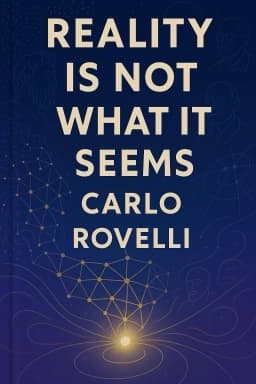
Beyond the Big Bang: How Quantum Gravity Redefines Our Cosmic Origins
A fascinating look at how quantum gravity offers new answers to the mysteries of the universe’s beginning and black holes.

The origin of the universe has captivated human imagination for millennia. Classical cosmology portrays the Big Bang as a singular beginning, a point of infinite density and temperature. However, Carlo Rovelli’s quantum gravity offers a transformative perspective: the universe may be finite yet without boundaries, akin to the surface of a sphere extended into three dimensions—a 3-sphere.
This topology means that traveling in a straight line could bring you back to your starting point, removing the paradoxes of infinite space and edges. Moreover, quantum gravity suggests that what we perceive as the Big Bang might be a quantum bounce, a transition from a contracting phase to expansion, avoiding the problematic singularity predicted by classical physics.
Black holes, too, are reimagined. No longer eternal prisons, they emit radiation and possess entropy tied to quantum states of their horizons. This discovery unites thermodynamics, quantum mechanics, and gravity, revealing black holes as thermodynamic objects with deep informational significance.
Recent detections of gravitational waves confirm that spacetime itself is dynamic, rippling with energy and information. These observations lend support to the quantum gravity framework, which treats spacetime as a granular, evolving fabric.
By weaving together these insights, Rovelli’s work offers a coherent and elegant narrative of cosmic origins and evolution. It challenges us to rethink our place in the universe and inspires a profound sense of wonder at the quantum tapestry underlying all existence.
Want to explore more insights from this book?
Read the full book summary