
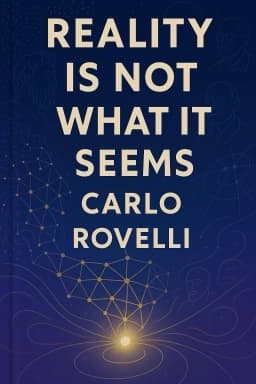
The Quantum Leap: How Carlo Rovelli’s Relational Mechanics Changes Everything About Reality
Explore the groundbreaking interpretation that physical properties exist only through relationships.

Quantum mechanics has long puzzled scientists and philosophers alike with its strange implications. Among the many interpretations, Carlo Rovelli’s relational quantum mechanics stands out by proposing a radical shift: physical properties do not exist absolutely but only in relation to other systems. Imagine a world where an electron’s position is not a fixed fact but something that depends on how and with what it interacts.
This relational view dissolves paradoxes like Schrödinger’s cat and quantum entanglement by emphasizing that observations are interactions producing correlations. Properties emerge from these interactions, much like colors appear only when light reflects off surfaces and reaches our eyes.
Rovelli’s interpretation aligns with the broader quantum gravity program, where space and time themselves are relational and emergent. It challenges the classical worldview, inviting us to see the universe as a dynamic web of interconnected events, where the observer and the observed are intertwined.
Consider the analogy of a conversation: words and meanings arise only between speakers. Similarly, quantum properties arise only in the context of interactions. This relational ontology not only clarifies conceptual puzzles but also offers a coherent framework for unifying physics.
Drawing on Rovelli’s writings and contemporary analysis, this post makes relational quantum mechanics approachable and engaging. It encourages readers to rethink the nature of reality and embrace the profound interconnectedness at the heart of existence.
Want to explore more insights from this book?
Read the full book summary