
From Chaos to Control: How Geometry and Networks Shape Football Strategy
Explore the hidden geometric patterns and network science that empower teams to dominate the pitch.

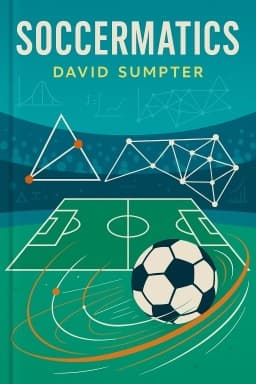
At first glance, a football match looks like a whirlwind of movement, with players darting unpredictably and the ball weaving through the chaos. Yet, as David Sumpter reveals in Soccermatics, this apparent disorder hides a remarkable order grounded in geometry and network science.
One of the fundamental geometric structures in football is the triangle. Teams like Barcelona famously form passing triangles that maximize options and maintain fluid ball movement. Each triangle allows players to pass in multiple directions, reducing the risk of losing possession and creating space. These triangles are not static; they shift dynamically as players move, maintaining optimal spacing and connectivity.
To understand why triangles are so effective, we look to nature. Slime moulds, single-celled organisms, solve complex network problems by growing tubular connections between food sources. When presented with maps of cities, these moulds create networks remarkably similar to human-designed train systems. This natural optimization mirrors how football teams build efficient passing networks to connect players and control space.
Passing networks visualize players as nodes connected by weighted links representing pass frequency. Centrality measures identify key players who act as hubs, distributing the ball and driving play. For example, midfielders with high centrality often orchestrate attacks and maintain possession.
Defensive formations can be analyzed using convex hulls, geometric shapes enclosing defenders’ positions. A smaller convex hull indicates a compact defense that limits attacking space, while a larger one suggests vulnerability. Coaches use these visualizations to adjust tactics and respond to opponents’ strategies.
These concepts extend beyond football. The same geometric and network principles apply to pedestrian movement, animal behavior, and urban planning, illustrating the universality of these patterns. Football thus serves as a living laboratory for understanding complex systems and spatial dynamics.
By embracing geometry and networks, teams gain a strategic edge, turning chaos into control. This blend of science and sport enriches our appreciation of football’s beauty and complexity, revealing the invisible threads that connect players and shape every match.
Understanding these spatial patterns empowers fans and practitioners alike to see football through a new lens—one where math and movement combine to create the beautiful game’s enduring magic.
Want to explore more insights from this book?
Read the full book summary