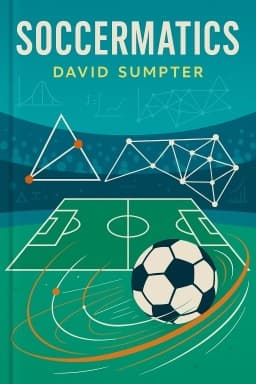
David Sumpter
An engaging exploration of how mathematics illuminates the patterns, strategies, and analytics behind the game of football.
The Poisson distribution used to model football goals was first applied to soldiers accidentally killed by horse kicks in 19th century Germany.
Section 1
9 Sections
Imagine a football match as a dance of chaos and order, where the ball weaves unpredictably among players, and goals seem to arrive as sudden bursts of fortune or misfortune. Yet beneath this apparent chaos lies a profound mathematical rhythm.
Picture a season of football matches: some games end in dull 0-0 draws, others explode with 5 or even 10 goals. When all these results are plotted, a distinctive pattern emerges. The number of matches with zero goals, one goal, two goals, and so forth, falls into a curve that matches the Poisson distribution remarkably well. This means that while each goal’s timing is unpredictable, the overall distribution of goals across a season is not.
This pattern is not unique to football. It echoes in the natural world and human affairs—from the number of lightbulbs that fail each year to the frequency of tragic accidents involving horses. In fact, the very statistical tool that explains football goals was first applied to analyze how often soldiers were accidentally killed by horse kicks in the 19th century.
One might think that randomness implies chaos and unpredictability, but paradoxically, it is the randomness of goals that allows us to predict their overall distribution. For example, by knowing the average number of goals per match, we can simulate entire seasons and estimate how often teams might win or lose. These simulations produce league tables that, while not exact, closely resemble real-world outcomes.
Yet, randomness is not the whole story. It sets the stage, the canvas on which the drama unfolds. On this canvas, teams and players paint their strategies and skills, creating moments of brilliance that defy pure chance. Understanding this balance between randomness and structure opens a new way of seeing football—not just as a game of chance, but as a dance between order and unpredictability.
As we move forward, we will explore how teams organize themselves on the pitch, creating passing networks and spatial formations that turn randomness into opportunity. These structures reveal how mathematics and football intertwine at a deeper level, shaping the beautiful game we love.
What mathematical distribution is used to model the timing of goals in football matches?
17 more quizzes available in app
The timing and number of goals in football matches are effectively random but follow a predictable statistical pattern.
8 more insights available in app
Unlock all 9 sections, 9 insights, full audio, and interactive mind map in the SnapBooks app.
Discover the surprising mathematical patterns and insights that reveal the secrets behind soccer’s unpredictable magic.
Read articleExplore the hidden geometric patterns and network science that empower teams to dominate the pitch.
Read article