
Unlocking Soccer’s Hidden Code: How Mathematics Explains the Beautiful Game
Discover the surprising mathematical patterns and insights that reveal the secrets behind soccer’s unpredictable magic.

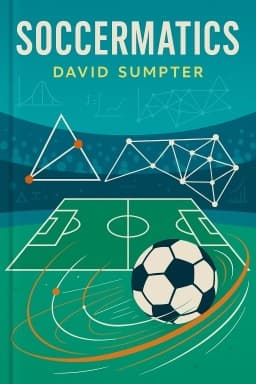
Soccer is often celebrated for its unpredictability, the last-minute goals, the stunning passes, and the emotional rollercoaster it offers millions worldwide. But what if beneath this apparent chaos lies a hidden order governed by mathematical principles? This is the central thesis of David Sumpter’s Soccermatics, a groundbreaking book that peels back the layers of the beautiful game to reveal the science and math that underpin it.
One of the most striking revelations from the book is the role of randomness in goal scoring. While fans often see goals as moments of pure skill or luck, the timing and number of goals in matches follow a predictable statistical distribution known as the Poisson distribution. This means that although each goal appears unpredictable, the overall pattern across a season is remarkably stable. This insight connects football to broader natural phenomena, showing how random events can create order over time.
Moving from goals to gameplay, Sumpter explores how teams use geometry and networks to control space. The formation of passing triangles maximizes options and maintains fluidity, a strategy famously employed by teams like Barcelona. Interestingly, nature provides analogies through slime moulds that build efficient networks connecting food sources, mirroring how players connect through passes on the pitch.
Player movement is another area where mathematics shines. Flow fields map how players move in response to opponents and teammates, revealing defensive strategies that are mathematically unbeatable in one-on-one scenarios. These concepts extend beyond football, reflecting patterns in pedestrian movement and animal hunting tactics.
The book also dives into the science of exceptional performances. Using extreme value theory, it quantifies how rare feats like Messi’s 50-goal season are statistically extraordinary, akin to once-in-a-lifetime events. This statistical brilliance parallels analyses in climate science, showing the interdisciplinary nature of these models.
When it comes to the magic of the perfect shot, physics explains much but not all. Aerodynamics, spin, and ball design influence trajectory, but moments of brilliance retain an element of mystery that transcends equations.
Managers influence the game through strategy and incentives. The shift to awarding three points for a win transformed tactics, encouraging attacking play. Managerial strategies evolve like natural selection, shaped by experience and competition.
Visual tools like passing networks and tactical maps help decode team styles and player roles, while the wisdom of crowds and betting markets reveal the complexities of collective intelligence and social influence.
Ultimately, Soccermatics portrays football as a rich microcosm where mathematics and human creativity coexist. It invites us to appreciate the game not only for its excitement but also for its deep structural beauty, offering insights that resonate far beyond the pitch.
Whether you’re a die-hard fan or a curious newcomer, understanding the math behind football enriches your experience and opens new ways to engage with the sport. Dive into Soccermatics and discover the beautiful symphony of numbers and passion that makes football truly magical.
Want to explore more insights from this book?
Read the full book summary