
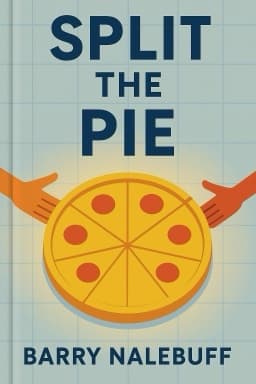
Unlocking Negotiation Secrets: How ‘Split the Pie’ Will Change Your Deal-Making Forever
Discover the revolutionary framework that transforms negotiation from a tug-of-war into a fair, value-creating partnership.

Negotiation is often portrayed as a battlefield where each party fights to claim the largest slice of a fixed pie. This perspective fosters adversarial dynamics, mistrust, and often leaves value on the table. Barry Nalebuff’s groundbreaking book, ‘Split the Pie,’ challenges this zero-sum mindset by introducing the concept of the negotiation pie — the additional value created when parties cooperate. This simple yet profound idea transforms negotiation from a contest into a collaborative process focused on fairness and value creation.
At its core, the negotiation pie is not the total resources available but the incremental value generated by working together beyond what each party can achieve alone. For example, if two companies can individually produce $10 million in sales but together can generate $25 million, the pie to split is the extra $5 million created by their collaboration.
This reframing has powerful implications:
- Fair Division: The pie should be split based on the value each party brings and their fallback options, ensuring fairness rather than arbitrary splits.
- Cost Sharing: The same logic applies to dividing costs or burdens, focusing on the savings created by cooperation rather than total costs.
- Handling Complexity: Even in multi-party or asymmetric negotiations, the principle of equal contribution to creating value holds, debunking common myths about power.
- Growing the Pie: Empathy and creativity enable parties to expand the pie by understanding each other’s interests and making smart trades.
Consider a compelling example where two divisions coordinate travel plans. Individually, each pays $1,000 for round-trip airfare. By creating a triangular route, they save $1,000 together. The fair split is not dividing the total airfare but sharing the $1,000 savings equally. This illustrates how focusing on the incremental value — the negotiation pie — leads to fairness and cooperation.
Preparation is equally vital. Knowing your Best Alternative to a Negotiated Agreement (BATNA) and accurately measuring the pie empowers you to make principled arguments and strategic offers. Information sharing must be balanced — too much transparency can weaken your position, too little breeds mistrust. Opening offers anchored in pie logic invite collaboration rather than conflict.
Perhaps most importantly, negotiation blends logic with empathy. Understanding the other party’s true interests builds trust and uncovers new avenues for value creation. This holistic approach leads to durable agreements and lasting relationships.
Why does this matter to you? Whether negotiating a business deal, salary, or partnership, applying the pie framework ensures you negotiate from a position of fairness and insight. It reduces conflict, maximizes value, and fosters cooperation — transforming negotiation from a dreaded chore into an opportunity for mutual gain.
In the following blogs, we will explore each of these insights in depth, providing practical tips and vivid examples to help you master the art and science of negotiation.
Prepare to change your negotiation game forever.
Sources: 1 , 2 , 3
Want to explore more insights from this book?
Read the full book summary