
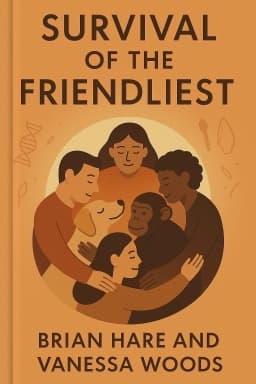
How Friendliness Rewrote the Rules of Evolution and Could Save Our Future
Explore how the evolution of friendliness transformed life on Earth and why it holds the key to solving today’s biggest challenges.

Evolution is often portrayed as a brutal contest where only the strongest survive. Yet, research reveals a subtler truth: friendliness and cooperation are powerful forces that have shaped life’s trajectory. The domestication of foxes illustrates this beautifully, showing how selecting for social tolerance leads to profound biological and behavioral changes.
Among primates, bonobos and chimpanzees provide a living contrast. Bonobos’ peaceful, cooperative societies demonstrate that tolerance can be a successful survival strategy, supported by hormonal and neurological differences. Humans, as self-domesticated creatures, evolved reduced aggression and enhanced social cognition, enabling cultural complexity and cooperation on an unprecedented scale.
However, the social brain’s capacity for empathy can also be suppressed, leading to dehumanization and cruelty, especially in political contexts. This paradox challenges us to understand and navigate the dual nature of friendliness in society.
Meaningful contact and friendship across divides emerge as powerful tools for reducing prejudice and fostering peace. These principles support democratic governance, which depends on cooperation and mutual respect. As polarization threatens social cohesion, restoring friendliness is vital.
Looking to the future, expanding empathy and embracing nonviolent cooperation are essential strategies for addressing global challenges such as climate change, inequality, and conflict. Our evolutionary heritage shows that friendliness is not just a moral ideal but a survival imperative.
References:
: Fox domestication research
: Primate social behavior and neuroscience
: Human evolutionary anthropology
: Social psychology of intergroup relations
: Political science on democracy and polarization
Want to explore more insights from this book?
Read the full book summary