
Is Empathy the Secret Superpower That Evolution Forgot to Tell You About?
Uncover the surprising evolutionary roots of empathy and why it might be our greatest survival tool yet.

For centuries, the dominant narrative about life and evolution has been one of cutthroat competition — survival of the fittest, where only the strongest or the most ruthless prevail. But what if this story is incomplete? What if beneath the surface of competition lies a powerful current of empathy and cooperation that has quietly shaped the destiny of species, including our own?
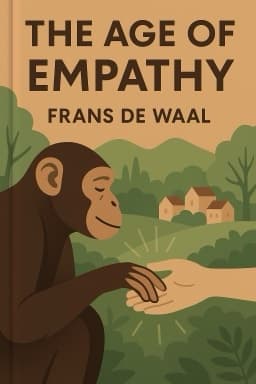
This image captures the tender moment of connection between species, highlighting empathy's evolutionary roots.
Recent research in evolutionary biology and social neuroscience reveals that empathy is not an accident of culture or morality but a deeply ingrained biological trait. Primates, rodents, and many social animals display behaviors that suggest they feel the emotions of others — consoling, sharing, and cooperating in ways that enhance group survival. For example, musk oxen in the harsh Siberian tundra survive by forming protective circles around their young, demonstrating mutual aid against predators and the cold. This is empathy in action, a cooperative strategy that benefits the group and individual alike.
Such examples challenge the old view that evolution favors only selfishness. Instead, empathy emerges as a vital glue that binds individuals into communities, promoting social bonds that improve health and longevity. Studies show that individuals with strong social connections live longer and healthier lives, underscoring empathy's role in well-being.
At the neurological level, mirror neurons provide a fascinating mechanism for empathy. These neurons fire both when we perform an action and when we observe others doing the same, allowing our brains to simulate others' experiences. This neural mirroring explains phenomena like contagious yawning or why couples grow to resemble each other over time — subtle bodily synchronies that deepen emotional connection.
Empathy also underpins our sense of fairness and justice. Capuchin monkeys, for instance, reject unequal rewards, signaling an innate sensitivity to fairness that supports cooperation and social harmony. However, empathy is not without its limitations. It tends to be selective, favoring those within our social group and sometimes excluding outsiders. Psychopaths, who lack emotional empathy, illustrate how this capacity can be suppressed or absent, leading to manipulation and cruelty.
In modern society, empathy faces challenges from economic inequality, political polarization, and social fragmentation. Yet, education and social policies offer promising paths to cultivate empathy, fostering emotional intelligence and social responsibility from early childhood through adulthood. Empathy is not fixed; it can grow and strengthen, offering hope for a kinder, more just world.
Ultimately, empathy is more than a feeling — it is a biological imperative, a social glue, and a path to personal and collective healing. Embracing empathy could be humanity's greatest superpower yet, transforming how we live, relate, and thrive together.
References: Insights from Frans de Waal's evolutionary studies, Adam Smith's moral philosophy, and recent social neuroscience research all converge to illuminate empathy’s profound role in nature and society.[[0]](#__0) [[1]](#__1) [[2]](#__2)
Want to explore more insights from this book?
Read the full book summary