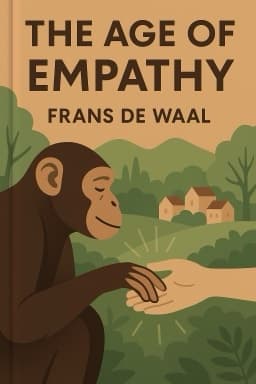
Frans de Waal
A groundbreaking exploration of empathy’s evolutionary roots and its vital role in creating kinder, more cooperative societies.
Chimpanzees have been observed consoling each other after fights, similar to human comforting behaviors.
2 more facts available in the app
Section 1
10 Sections
Imagine waking up to a world where the common assumption is that every creature, including humans, is driven solely by selfish ambition and ruthless competition. This has been the dominant narrative for centuries, painting a bleak picture of nature as a brutal arena where only the fittest survive.
Empathy’s roots stretch far beyond humanity. Studies of primates reveal remarkable behaviors where individuals console one another after conflicts, share food, and even risk their own safety to protect companions. These acts are not random but are evolutionary adaptations that enhance group survival. Similarly, rodents display emotional contagion, reacting to the distress of their peers in ways that suggest a shared emotional experience.
Moreover, social bonds have tangible effects on health and longevity. In both humans and animals, those with strong social networks tend to live longer, healthier lives. The very act of bonding reduces stress hormones and promotes well-being, illustrating empathy’s role not only as a social glue but as a life-sustaining force.
As we embark on this journey through the age of empathy, we begin to see that our nature is not a cold calculus of survival but a warm, intricate dance of giving and receiving care.
Which statement best reflects the book's view on human nature?
19 more quizzes available in app
Empathy is deeply embedded in our biology, serving as a glue that holds societies and animal groups together.
8 more insights available in app
Unlock all 10 sections, 9 insights, full audio, and interactive mind map in the SnapBooks app.
Uncover the surprising evolutionary roots of empathy and why it might be our greatest survival tool yet.
Read articleExplore the surprising science of empathy’s bodily language and its powerful influence on fairness and social bonds.
Read article
Stephanie Cacioppo

Peter Forbes

Rebecca K. Smith

Thor Hanson
