
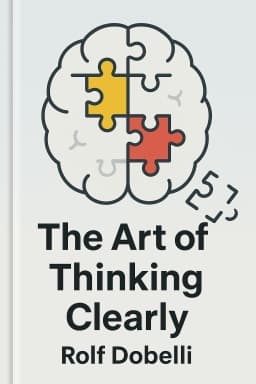
Think Smarter, Not Harder: Mastering the Mental Pitfalls That Hold You Back
A deep dive into the cognitive traps that cloud judgment and how to break free for better outcomes.

Clear thinking is a skill that can be cultivated by understanding the cognitive errors that cloud our minds.
Survivorship Bias: The Mirage of Success
\We tend to admire winners and emulate them, forgetting the silent majority who fail. This bias leads to unrealistic expectations and risky choices. For example, aspiring entrepreneurs often overlook the high failure rate, focusing only on success stories.
\ \Swimmer’s Body Illusion: Confusing Cause and Effect
\Success often depends on traits present before effort. Mistaking the effect for the cause leads to misguided efforts. Recognizing this helps in setting achievable goals aligned with personal strengths.
\ \Clustering Illusion: Seeing Order in Randomness
\Our brain’s craving for patterns causes us to see connections where none exist. This illusion fuels superstitions and faulty predictions. Developing statistical literacy aids in discerning real patterns.
\ \Social Proof: The Herd Effect
\Following the crowd feels safe but can lead to irrational behavior. Being aware of this instinct allows us to pause and evaluate independently.
\ \Sunk Cost Fallacy: Breaking Free from the Past
\Emotional attachment to past investments traps us in losing situations. Learning to let go is crucial for growth and resource optimization.
\ \Reciprocity: The Invisible Social Contract
\Reciprocity drives social bonds but can be exploited. Recognizing when gifts are strategic helps maintain autonomy.
\ \Confirmation Bias: Challenging Your Own Beliefs
\We favor information that confirms our views, limiting understanding. Practicing intellectual humility and seeking diverse perspectives counteracts this bias.
\ \Want to explore more insights from this book?
Read the full book summary