
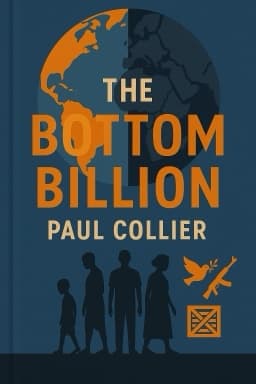
Why Are a Billion People Still Left Behind? Unpacking the Shocking Truths of 'The Bottom Billion'
Discover the hidden forces that keep a billion people trapped in poverty and what can be done to break the cycle.

Imagine a world where almost a billion people live in countries that are not just poor but stuck in a downward spiral of economic decline and conflict. This is the sobering reality unveiled in Paul Collier's profound work, The Bottom Billion. While global headlines often celebrate the rapid growth of giants like China and India, the story of the bottom billion remains largely untold — a story of stagnation, despair, and complex traps that defy simple solutions.
The Bottom Billion Defined
These are not just the poorest people; they are the populations of countries whose economies have failed to grow or have even shrunk over the past several decades. Concentrated mainly in Africa and parts of Central Asia, these nations suffer from extreme poverty, low life expectancy, and high infant mortality. Their plight is hidden in global averages because their small economies are overshadowed by booming giants.
The Conflict Trap
One of the most devastating forces keeping these countries poor is violent conflict. Civil wars, coups, and internal strife destroy infrastructure, displace millions, and kill more through disease and starvation than direct violence. Conflict is both a symptom and a cause of poverty, creating a vicious cycle that is hard to break. For example, many of these countries have a risk of civil war that is double that of better-off nations, fueled by poverty, weak governance, and resource competition.
The Natural Resource Curse
Paradoxically, resource wealth can become a curse rather than a blessing. Countries rich in oil, diamonds, or minerals often suffer from 'Dutch disease,' where resource exports cause currency appreciation that kills off other export sectors. Politically, resource rents enable corruption and patronage, weakening democracy and accountability. Countries with strong institutions can manage resources well, but many of the bottom billion lack these safeguards.
Geographic Challenges: Landlocked and Isolated
Geography plays a powerful role. Nearly 40% of the bottom billion live in landlocked countries surrounded by poor neighbors. Without access to ports, transport costs skyrocket, limiting trade and investment. When neighbors are conflict-ridden or protectionist, isolation deepens, trapping economies in low growth.
Governance: The Necessary but Not Sufficient Ingredient
Good governance and sound policies are vital for growth but cannot create opportunities where geography, conflict, or resource traps dominate. Reform requires courageous leaders, skilled bureaucrats, and often external support. Many countries struggle to break old patterns due to entrenched interests and capacity shortages.
Globalization’s Unequal Reach
Globalization has lifted billions but has left the bottom billion largely on the sidelines. Agglomeration economies favor established exporters, and trade barriers in rich countries limit market access for poor exporters. Capital flight through illicit financial flows further drains resources.
Aid and Intervention: Tools with Limits
Aid can stabilize fragile states and support recovery but cannot substitute for growth. Military interventions can help secure peace but require long-term commitment and coordination. Fragmented aid efforts often reduce effectiveness.
Laws, Charters, and Trade Policy
International transparency initiatives and trade preferences can empower reformers and improve governance. Legal frameworks protect investments and encourage capital flows, but require enforcement and political will.
An Agenda for Action
Breaking these traps demands integrated international efforts, long-term commitment, and empowering local reformers. The struggle is daunting but essential for global stability and justice.
Understanding these complex dynamics is the first step toward meaningful change. The bottom billion’s fate is intertwined with ours, and their progress will shape the future of our interconnected world.
Sources: supersummary.com, blinkist.com, shortform.com, wikipedia.org
Want to explore more insights from this book?
Read the full book summary