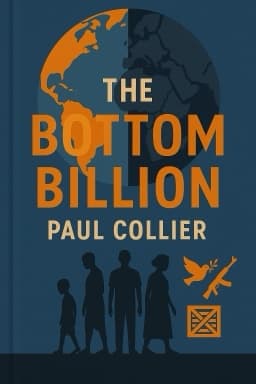
Paul Collier
An in-depth analysis of why the poorest billion remain trapped in poverty and conflict, and what coordinated global actions can help break these traps.
Paul Collier's work helped popularize the term 'bottom billion' to describe the poorest segment of the global population.
Section 1
9 Sections
Imagine a world divided not just by wealth but by a chasm of opportunity and despair. There exists a group of nearly one billion people who live in countries where economic progress has stalled or even reversed over decades. These people, often forgotten in the grand narratives of global development, form what we now call the 'bottom billion.'
They are predominantly located in Africa and parts of Central Asia, places where life expectancy averages only 50 years, and infant mortality rates are alarmingly high. To put this in perspective, their average income per person is only about one-fifth that of their counterparts in other developing countries. This is not just a story of relative poverty but of absolute decline and despair.
What makes this group particularly striking is that their stagnation is hidden in global statistics. When growth is averaged by the size of a country’s economy, the booming giants like China and India overshadow these smaller, poorer nations. But when we weight growth by population, the picture changes dramatically. The typical person in the bottom billion experiences little to no improvement in living standards, while billions elsewhere rise steadily.
Understanding this divide is crucial because it shapes global stability and the future of development efforts. The plight of the bottom billion is not just their problem; it is a challenge for the entire world. As their societies languish, the risks of conflict, migration pressures, and economic instability grow, affecting us all.
As we begin to explore this vast and complex issue, we will delve into the traps that keep these countries stuck and the instruments available to help them break free. The journey ahead is sobering but filled with hope for change.
Let us now turn our attention to the first and most visible of these traps: conflict, a force that has torn apart many of these societies and perpetuates their suffering.
Where are most of the bottom billion people located?
17 more quizzes available in app
They are not just poor but stuck in a pattern of stagnation or decline, separated from the rest of the developing world.
8 more insights available in app
Unlock all 9 sections, 9 insights, full audio, and interactive mind map in the SnapBooks app.
Discover the hidden forces that keep a billion people trapped in poverty and what can be done to break the cycle.
Read articleDelve into the vicious cycles of conflict and resource wealth that stall development in the world’s poorest nations.
Read article