
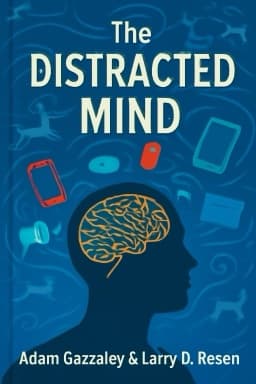
Why You Can’t Focus (And What To Do About It): The Surprising Science Behind Distraction
Unlocking the Hidden Forces That Steal Your Attention—and How to Outsmart Them

Have you ever sat down to finish a simple task, only to find yourself lost in a maze of emails, texts, and half-remembered to-dos? You’re not alone. The struggle to focus is a universal experience, and according to The Distracted Mind, it’s not your fault. Our brains, shaped by millennia of evolution, are built to seek new information, constantly scanning for potential threats or opportunities. In the ancient world, this made sense—missing a sign of danger could be fatal, and spotting a new food source meant survival. But in today’s world, this same wiring leaves us vulnerable to the endless stream of digital distractions.
The Ancient Brain in a Modern World
The prefrontal cortex, the seat of executive function, is responsible for goal-setting, planning, and impulse control. But it’s also limited by its capacity—our working memory can only hold a handful of items at once. When we try to juggle multiple streams of information, like checking our phone while working, we’re not truly multitasking. Instead, our brain rapidly switches between tasks, incurring a cost each time. This switching doubles errors, slows us down, and leaves us feeling mentally exhausted.
The Myth of Multitasking
Despite what we tell ourselves, multitasking is mostly an illusion. Research cited in the book shows that people who attempt to do many things at once perform worse on memory and attention tests. Students who text during class, for example, remember less and score lower—even if they believe they’re keeping up. The cost isn’t just cognitive; it’s emotional, with multitasking raising stress and anxiety levels.
Technology: Friend or Foe?
Technology amplifies our brain’s vulnerabilities. App designers leverage the same reward pathways that once helped us forage for food or avoid predators. Each notification, each like or message, triggers a small burst of dopamine, making it hard to resist checking our devices hundreds of times a day. But the book also offers hope: by understanding these mechanisms, we can reclaim our attention.
Reclaiming Your Focus
The authors recommend science-backed strategies for regaining control. Mindfulness meditation, for example, increases the thickness of brain regions involved in attention. Nature walks restore cognitive resources depleted by constant stimulation. Even simple changes—like silencing notifications, organizing your workspace, or scheduling focused work blocks—can make a dramatic difference.
Building Better Habits
Lasting change comes from small, consistent actions. Setting boundaries with technology, taking regular breaks, and practicing self-compassion when your mind wanders all contribute to a more focused, fulfilling life. Distraction isn’t a personal failing—it’s a natural part of being human. By embracing this truth, you can design a life that works with your brain, not against it.
Ready to take back your attention? Understanding the science is just the first step. With intention and practice, you can transform distraction into creativity, productivity, and joy.
References: The Distracted Mind, Blinkist summary, LifeClub review, The Brain Blog
Want to explore more insights from this book?
Read the full book summary