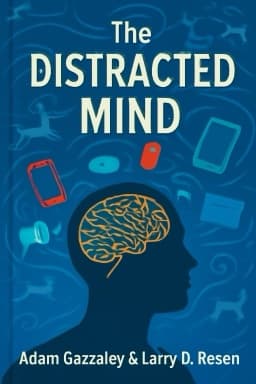
Adam Gazzaley and Larry D. Rosen
A science-based guide to understanding and overcoming distraction in a high-tech world.
The book uses optimal foraging theory, originally developed for animal behavior, to explain why humans constantly switch between information sources.
Section 1
9 Sections
Let me take you on a gentle journey, one that begins not with the clamor of your phone or the ping of an email, but with the soft footfalls of our ancestors padding through the forest. Imagine, for a moment, stepping into a world where the greatest distractions were the rustle of leaves, the distant call of a bird, or the sudden snap of a twig behind you.
Consider the simple act of walking into the kitchen and forgetting why you came. Or sitting with a friend, your mind drifting to an unresolved worry. These are not failures of willpower; they are echoes of ancient wiring. Our brains, after all, evolved not to focus on a single task but to scan for threats and opportunities, to remain ever-vigilant in a world of uncertainty. This vigilance, so crucial for survival, means that our attention is always ready to leap at novelty or danger, even when we wish it would stay put.
But something remarkable happened as our species evolved: we became creatures of goals. We learned to plan, to imagine, to set our sights on distant futures. Yet, as our ability to dream grew, our capacity to control our attention did not keep pace.
Think of the executive who forgets a key point in a meeting because a stray thought intrudes, or the artist who loses a creative thread after a phone buzzes. These are not modern maladies; they are the human condition. Even the most advanced brains, the most disciplined minds, are subject to these lapses. The book reminds us that everyone, from the scientist to the student, the parent to the poet, is touched by interference.
What is interference? It is the static that disrupts our mental radio, the noise that drowns out our intentions. It comes in many forms: internal distractions like worries or daydreams; external distractions like sounds, sights, or notifications; and interruptions, those moments when we attempt to juggle multiple goals at once. Each pulls us away from our chosen path, sometimes gently, sometimes with a jolt.
Yet, there is solace in this understanding.
As we move forward, let us remember that the struggle with distraction is not a failing, but a story as old as our species. And in this story, understanding is the first step toward wisdom. Next, we will explore how the very mechanisms that once kept us safe now collide with the relentless pace of our high-tech world. Let’s step into the landscape of modern technology and see how it amplifies our ancient vulnerabilities.
What is a fundamental reason for distraction according to 'The Distracted Mind'?
17 more quizzes available in app
Both distractions and interruptions challenge our ability to focus.
7 more insights available in app
Unlock all 9 sections, 8 insights, full audio, and interactive mind map in the SnapBooks app.
Unlocking the Hidden Forces That Steal Your Attention—and How to Outsmart Them
Read articleHow Everyday Tech Habits Shape Your Mind—And Simple Fixes for a Healthier Brain
Read article