
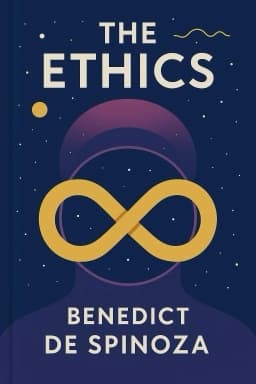
Unlocking the Infinite: How Spinoza’s God Redefines Our Universe and Ourselves
Discover the revolutionary idea of God as the infinite substance that changes everything we thought about existence and self.

Imagine a universe where everything you see, think, and feel is not a collection of separate things but expressions of one infinite essence. This is the core of Spinoza's philosophy, where God is not a personal deity standing apart from creation but the
Spinoza’s approach is rigorous and mathematical, using a geometric method inspired by Euclid’s Elements. Through precise definitions, axioms, and propositions, he builds a logical structure where each truth follows necessarily from the previous ones. This method guarantees certainty and clarity, making his philosophy not just speculative but demonstrably true within its framework.
The infinite substance — God or Nature — is self-caused, meaning its essence contains existence necessarily. From this flows a deterministic universe where nothing happens by chance or free will in the traditional sense. Every mode or thing is a modification of this substance, expressing one or another attribute such as thought or extension.
Consider the mind and body, often thought of as separate. Spinoza reveals they are two attributes of the same substance, inseparably linked. The mind is the idea of the body, and every bodily change corresponds to a mental idea. This unity dissolves the mind-body problem and provides a holistic understanding of human experience.
This vision invites us to see ourselves and the cosmos as interconnected, harmonious, and necessary. It offers a foundation for ethics, knowledge, and freedom grounded in reality’s true nature.
By embracing this infinite unity, we move beyond fragmented views of existence and enter a world where understanding and peace flow naturally. As we continue, we will explore how this foundation shapes knowledge, emotions, human weakness, and ultimately freedom and happiness.
Sources: Stanford Encyclopedia of Philosophy, Internet Encyclopedia of Philosophy, The Ethics by Benedict de Spinoza
Want to explore more insights from this book?
Read the full book summary