
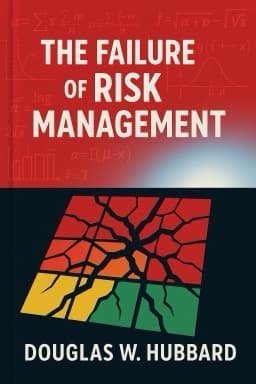
Why Most Risk Management Fails — And How You Can Fix It Today
Uncover the hidden flaws in traditional risk management and discover a proven path to measurable, reliable risk control.

Introduction: The Invisible Crisis in Risk Management
Risk management is everywhere—from boardrooms to engineering projects, from financial portfolios to cybersecurity. Yet, despite its ubiquity, many organizations suffer catastrophic failures that reveal the deep flaws in how risk is understood and controlled.
The Roots of Failure: Common Mode Failures and Analysis Placebo
At the heart of many disasters is a 'common mode failure'—a single weak link triggering multiple system failures and rendering supposed redundancies ineffective. For example, software flaws in aircraft systems have caused fatal crashes despite multiple safety layers. Compounding this is the 'analysis placebo effect,' where organizations feel reassured simply by having formal risk processes, even though these processes do not measurably reduce risk. This false confidence is dangerous because it masks vulnerabilities and delays corrective action.
Why Do These Flaws Persist?
To understand why ineffective methods dominate, we must look at history. Risk management concepts date back to ancient Babylonian trade practices and evolved through actuarial science in insurance. Yet, despite advances, most firms still prefer qualitative methods because they are easier to use and communicate. Surveys show only about 20% of large organizations employ quantitative techniques like Monte Carlo simulations or Bayesian analysis. Barriers include lack of expertise, institutional inertia, and a comfort with consensus-driven qualitative rankings.
The Confidence-Accuracy Gap: Why Self-Assessments Mislead
Studies reveal a troubling gap between confidence and accuracy. People become more confident with more information or group discussion, but their actual decision accuracy rarely improves. This 'confidence-accuracy gap' is exacerbated by the Dunning-Kruger effect, where less skilled individuals overestimate their abilities. In risk management, this means many organizations overrate their effectiveness, relying on unverified self-assessments rather than empirical data.
The Quantitative Solution: One-for-One Substitution and Monte Carlo Simulation
The path forward lies in replacing vague qualitative scales with explicit probability and impact estimates. Experts provide probabilities that an event will occur within a defined timeframe, along with confidence intervals for potential losses. Monte Carlo simulations then aggregate these uncertainties into loss exceedance curves, showing the likelihood of various loss levels. This approach allows organizations to define risk tolerance and evaluate mitigation investments based on expected loss reductions, enabling data-driven, cost-effective decisions.
Refining Models with Empirical Data and Bayesian Updating
Quantitative models improve further by decomposing complex risks into manageable components and calibrating expert judgments with historical data. Bayesian updating integrates new evidence to refine probabilities dynamically, reducing uncertainty over time. These techniques transform risk management from static guesswork into a living, data-driven discipline.
Enhancing Expert Judgment: Calibration and Aggregation
Expert judgment remains vital but must be sharpened through calibration training, which reduces overconfidence and aligns confidence intervals with real-world outcomes. Aggregating multiple expert opinions, weighted by past accuracy, improves forecast reliability and mitigates individual biases. Together, these methods create a robust framework for leveraging human expertise effectively.
Building a Culture of Measurement and Continuous Improvement
Finally, sustainable risk management requires embedding a culture that values measurement, feedback, and accountability. Organizations that track forecast accuracy and reward careful analysis foster continuous learning and resilience. Integrating risk assessment into strategic decision-making ensures shared ownership and alignment with business goals.
Conclusion: From Illusion to Insight
The ultimate common mode failure is the failure of risk management itself. But by embracing quantitative methods, empirical validation, expert calibration, and a culture of measurement, organizations can transcend flawed traditions and build true resilience. This journey demands curiosity, discipline, and leadership willing to challenge assumptions. The rewards are safer, smarter decisions and a future where risk is managed with clarity and confidence.
Ready to transform your risk management? Start by questioning your current methods and exploring quantitative approaches—because what gets measured gets managed.
References:
Want to explore more insights from this book?
Read the full book summary