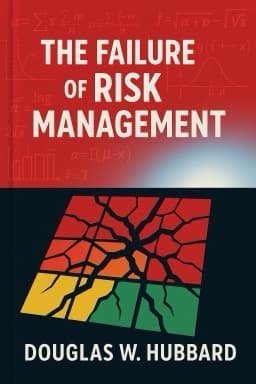
Douglas W. Hubbard
A critical examination of flawed risk management methods and a practical guide to adopting quantitative, scientifically validated approaches for better decision-making.
The term 'Monte Carlo simulation' was named after the famous gambling city because of its reliance on randomness and probability.
Section 1
7 Sections
Imagine a world where the systems designed to protect us from disaster are themselves flawed at their core. This is not a tale of negligence or outright ignorance, but rather a subtle and pervasive crisis in risk management.
But the problem runs deeper than engineering flaws. It extends to the very methods used to assess and manage risks. Many firms use qualitative tools like risk matrices, assigning vague labels such as 'high' or 'medium' risk, without grounding these assessments in measurable probabilities or impacts. This leads to a phenomenon known as the 'analysis placebo effect': organizations feel reassured simply because they have a structured process, but in reality, no improvement occurs.
Consider how this plays out in practice. A company may proudly present its risk register, filled with colorful charts and consensus-driven rankings, yet lack any objective evidence that these measures reduce the chance or impact of adverse events. Without measuring outcomes, how can one know if the approach works?
This lack of objective verification means that flawed methods spread unchecked, becoming entrenched as 'best practices' or even codified into standards and regulations. The consequences are not just financial losses but can include catastrophic failures impacting human lives and public safety.
Yet, there is hope. Recognizing the ultimate common mode failure—the failure of risk management itself—is the first step toward change. Understanding that a broken risk management process is the biggest risk an organization faces opens the door to adopting better, more scientific methods. These methods emphasize measurable probabilities, empirical data, and continuous validation.
As we move forward, we will explore the history and current state of risk management, why confusion and error persist, and how practical quantitative methods can transform the field. This journey will help us uncover the path from illusion to insight, from false reassurance to real resilience.
Now, let us delve into the history and current landscape of risk management to understand how we arrived at this crossroads.
What is a 'common mode failure' in risk management?
13 more quizzes available in app
Multiple failures linked by a single cause undermine redundancy.
8 more insights available in app
Unlock all 7 sections, 9 insights, full audio, and interactive mind map in the SnapBooks app.
Uncover the hidden flaws in traditional risk management and discover a proven path to measurable, reliable risk control.
Read articleHow embracing numbers and probability transforms risk management from guesswork to science.
Read article
Jeb Blount

Antoine van Agtmael and Fred Bakker

David Hoffeld

Jeb Blount
