
The Secret Forces That Toppled Rome: What Modern Civilizations Must Learn
How Climate and Disease Decided the Fate of the World’s Greatest Empire—and Why It Matters Now

How Climate and Disease Decided the Fate of the World’s Greatest Empire—and Why It Matters Now
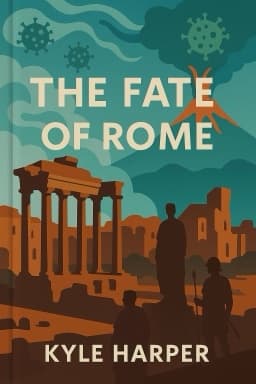
For centuries, the fall of the Roman Empire has been told as a tale of decadent emperors, barbarian invasions, and political intrigue. Yet, as historian Kyle Harper reveals in his revelatory book The Fate of Rome: Climate, Disease, and the End of an Empire, the true architects of Rome’s fate were often invisible: the shifting climate, volcanic eruptions, and the relentless march of pandemics. This blog peels back the marble façade of Roman history to reveal how nature—not just human ambition—decided the fate of the world’s greatest empire.
Rome’s rise coincided with a climatic golden age. During the so-called Roman Climate Optimum, warm and stable weather patterns nourished crops, filled granaries, and allowed the city to swell to over a million inhabitants—a record unmatched in the West for nearly two millennia. The Mediterranean’s blue arteries connected distant provinces, while rivers like the Nile and Tiber fed the empire’s insatiable appetite for grain and trade. But this prosperity came at a price: dense urbanization and interconnectedness made Rome a petri dish for disease. Malaria stalked the marshes, waterborne illnesses thrived in crowded neighborhoods, and the empire’s own roads and ships became vectors for pandemics.
The first great shock came with the Antonine Plague, likely smallpox, which decimated the population and left the empire reeling. Later, the Plague of Cyprian and the Justinianic Plague would sweep across continents, killing millions and shaking the very foundations of Roman society. Modern science, through the analysis of ancient DNA, has only recently confirmed the identities of some of these microbial killers—reminding us that history is often shaped by the smallest of actors.
Yet, Rome was resilient. For centuries, the empire adapted—raising taxes, reorganizing its governance, and relying on the ingenuity of local communities. Farmers dug new wells, religious groups tended to the sick, and cities improvised social safety nets. But resilience has its limits. As the climate grew more erratic after 150 AD, with periods of drought, cold snaps, and even volcanic winters, the empire’s systems began to buckle. Food shortages bred unrest, armies weakened, and the social contract that had bound Rome together started to fray.
What felled Rome was not a single disaster, but a cascade of overlapping crises—a ‘perfect storm’ of climate shocks, pandemics, invasions, and internal strife. The empire’s very strengths—its vastness, its urban scale, its connectivity—became vulnerabilities in the face of nature’s fury. In the end, Rome did not so much fall as transform, its legacy enduring in law, language, and culture, even as its old order faded away.
Today, as we confront our own era of climate instability and global pandemics, Rome’s story is more relevant than ever. Harper’s work is a call to humility before the forces of nature, a reminder that even the mightiest civilizations are not immune to environmental and epidemiological shocks. It is also a testament to the power of adaptation, innovation, and community—the very traits that allowed Rome to endure for centuries, and which remain our best hope for the future.
Further Reading: For a deeper dive into Harper’s arguments and the science behind them, see the Princeton University Press summary, TechRatchet’s detailed book review, and interviews with the author.
2
3
1
Want to explore more insights from this book?
Read the full book summary